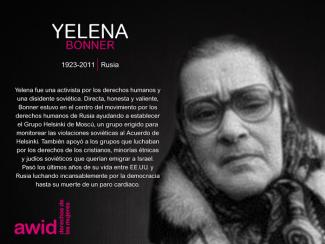
Yelena Bonner
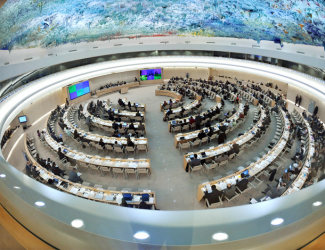
The Human Rights Council (HRC) is the key intergovernmental body within the United Nations system responsible for the promotion and protection of all human rights around the globe. It holds three regular sessions a year: in March, June and September. The Office of the UN High Commissioner for Human Rights (OHCHR) is the secretariat for the HRC.
Debating and passing resolutions on global human rights issues and human rights situations in particular countries
Examining complaints from victims of human rights violations or activist organizations on behalf of victims of human rights violations
Appointing independent experts (known as “Special Procedures”) to review human rights violations in specific countries and examine and further global human rights issues
Engaging in discussions with experts and governments on human rights issues
Assessing the human rights records of all UN Member States every four and a half years through the Universal Periodic Review
AWID works with feminist, progressive and human rights partners to share key knowledge, convene civil society dialogues and events, and influence negotiations and outcomes of the session.
AWID honors feminists and Women Human Rights Defenders (WHRDs) who have died and whose contributions to the advancement of human rights are very much missed.
AWID’s WHRD Tribute is a photo exhibition featuring feminist, women’s rights and social justice activists from around the world who are no longer with us.
The Tribute was first launched in 2012, at AWID’s 12th International Forum, in Turkey. It took shape with a physical exhibit of portraits and biographies of feminists and activists who passed away. The initiative was described by Forum participants as being a unique, moving and energizing way to commemorate our collective history.
At the 13th International Forum in Brazil, we honored activists and WHRDs with a mural unveiling ceremony in four languages, a dance performance and a Brazilian ritual.
In between the events, the Tribute lives as an online gallery that is updated every year as part of the 16 Days Campaign Against Gender Based Violence (25 November – 10 December).
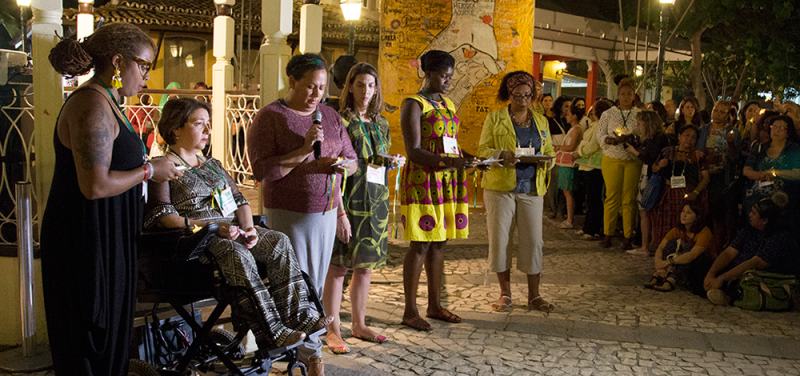
Since 2012, through our annual Tribute to Women Human Rights Defenders (WHRDs) no longer with us, over 400 feminists and WHRDs from 11 regions and 80 countries have been featured.
AWID would like to thank the families and organizations who shared their personal stories and contributed to this memorial. We join them in continuing the remarkable work of these women and forging efforts to ensure justice is achieved in cases that remain in impunity.
Visit the WHRD Tribute online exhibit
In addition to paying homage to these incredible activists, the Tribute particularly sheds light on the plight of WHRDs who have been assassinated or disappeared.
One third of those featured in the Tribute were activists who have been murdered or disappeared in suspicious circumstances. They were specifically targeted for who they were and the work they did to challenge:
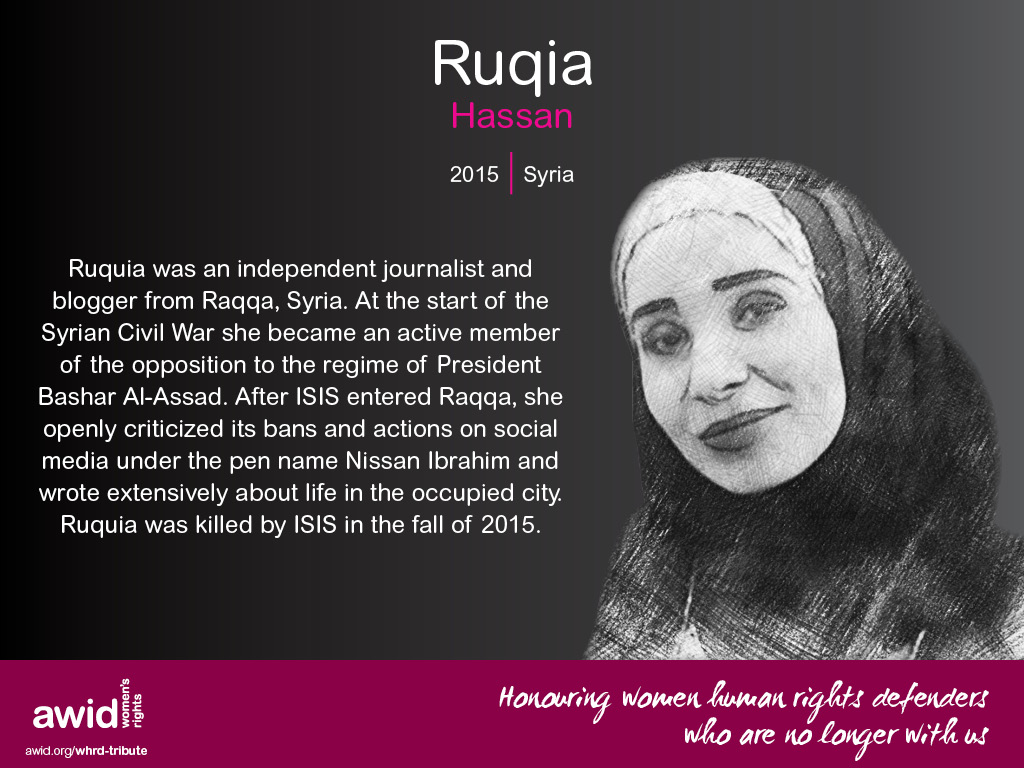
Women like Agnes Torres, from Mexico, was killed because of her gender identity and sexual orientation; or Cheryl Ananayo, an environmental activist from the Philippines was assassinated as she struggled against a mining company; or Ruqia Hassan, a Syrian independent journalist and blogger killed for her criticism of ISIS. And so many others.
With the WHRD Tribute, we bring them all into our collective memory and carry their legacy of struggle as our torch in the feminists’ and women’s rights movements. We recognize that security, safety and self-care must be a priority in all our political agendas. And we call on to governments and international bodies to collectively address violence against feminists and WHRDs.
Les Femmes Maintiennent les Soins | Les Soins Soutiennent la Vie | La Vie Soutient l'Économie | Qui s'Occupe des Femmes ? | Pas Une de Moins1 | Ensemble | Déjeuner du Dimanche
1Nenhuna a menos se traduit littéralement par « pas une femme de moins » ou « ni una menos » en espagnol - un célèbre slogan féministe en Amérique latine qui a émergé en Argentine en réponse à l'augmentation de la violence sexiste.
No. Valoramos tu trabajo, pero no estamos buscando respuestas de personas a título individual por el momento.
Contenido relacionado
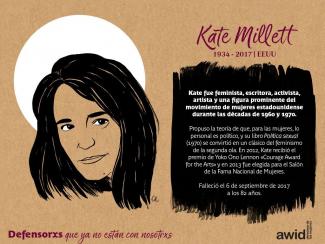
Huffington Post: Muere Kate Millett, activista y referente feminista
TeleSUR: Muere la autora feminista Kate Millett a los 82 años
Anglais, français, espagnol et chinois mandarin.
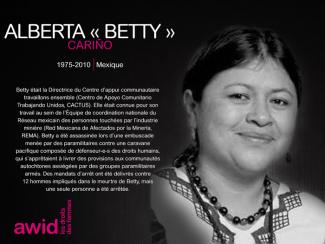
Este año honramos a 19 defensoras de la región de América Latina y el Caribe. De ellas, 16 fueron asesinadas, incluyendo a 6 periodistas y 4 defensoras LGBTQI. Únete a nosotras en la conmemoración de sus vidas y trabajo, compartiendo los memes aquí incluidos con tus colegas, amistades y redes; y tuiteando las etiquetas #WHRDTribute y #16Días.
Por favor, haz click en cada imagen de abajo para ver una versión más grande y para descargar como un archivo.


L’enquête est disponible sur KOBO, une plateforme en source libre de collecte, gestion et visualisation de données. Pour y participer, il vous suffit de cliquer ici sur le lien de l’enquête et de suivre les indications pour répondre aux questions.
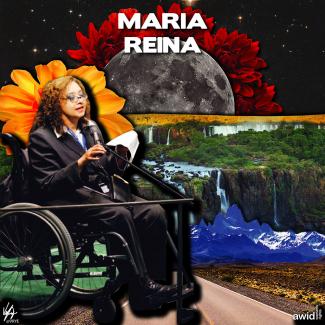
Elle a représenté l'International Disability and Development Consortium (consortium international sur le développement et le handicap) lors de la négociation de la Convention des Nations Unies relative aux droits des personnes handicapées (2001-2006). Son travail a été consacré à la réalisation de l'objectif de la Convention, à savoir la réalisation des droits humains universels par, pour et avec les personnes handicapées pour un monde inclusif, accessible et durable.
Selon ses propres mots, son leadership consistait à « … servir la communauté des personnes handicapées, en commençant par de petites tâches que d'autres pourraient ne pas vouloir faire».
Elle est décédée le 27 octobre 2017 dans sa ville natale de Rosario, en Argentine.
Pour en savoir plus sur María Verónica Reina, retrouvez son témoignage.
Nous mettrons le site à jour avec les informations pertinantes le moment venu.
7 Women Human Rights Defenders from across the South and Southeast Asian region are honored in this year’s Online Tribute. These defenders have made key contributions to advancing human and women’s rights, indigenous people’s rights, and the right to education. These WHRDs were lawyers, women’s rights activists, scholars, and politicians. Please join AWID in commemorating t their work and legacy by sharing the memes below with your colleagues, networks and friends and by using the hashtags #WHRDTribute and #16Days.
Please click on each image below to see a larger version and download as a file


What if we perceived land and Nature not as private property to exploit, but as a whole to live in, learn from, and harmoniously coexist with? What if we repaired our relationships with the land and embraced more sustainable alternatives that nurture both the planet and its communities?
Nous Sommes la Solution (We Are the Solution, NSS) is one of many women-led movements striving to do this. This is their story.

There are 47 questions in total, of which 27 are mandatory* and the remaining 20 are optional. The majority of questions are multiple-choice. We invite you to respond to all the questions.
Laura was a leading activist and lawyer who campaigned fearlessly for the decriminalisation of sex work in Ireland.
She is remembered as “a freedom fighter for sex workers, a feminist, a mother to a daughter and a needed friend to many.”
Laura advocated for individuals in the sex industry to be recognised as workers deserving of rights. She advanced demands for decriminalisation, including initiating a judicial review at Belfast’s high court in respect of the provisions criminalising the purchase of sex. Laura stated that her intention was to bring the case to the European Court of Human Rights.

Vous N’AVEZ PAS besoin d’un visa pour assister au Forum à Taipei si vous détenez un passeport émis par l’un des pays suivants (la durée de séjour autorisée varie d’un pays à l’autre) :
Allemagne, Andorre, Australie, Autriche, Belgique, Belize, Bulgarie, Brunei, Canada, Chili, Chypre, Croatie, Danemark, Espagne, Estonie, Eswatini, État de la Cité du Vatican, États-Unis, Finlande, France, Grèce, Guatemala, Haïti, Honduras, Hongrie, Îles Marshall, Islande, Irlande, Israël, Italie, Japon*, Lettonie, Liechtenstein, Lituanie, Luxembourg, Malaisie, Malte, Monaco, Nauru, Nicaragua, Norvège, Nouvelle-Zélande, Palaos, Paraguay, Pays-Bas, Philippines, Pologne, Portugal, République de Corée, République dominicaine, République tchèque, Roumanie, Royaume-Uni, Russie, Saint-Christophe-et-Niévès, Sainte-Lucie, Saint-Marin, Saint-Vincent-et-les-Grenadines, Singapour, Slovaquie, Slovénie, Suède, Suisse, Tuvalu.
Les personnes détentrices de tout autre passeport AURONT BESOIN D’UN VISA pour se rendre à Taipei.
Remarque :
Une fois inscrit·e au Forum, il est probable que vous receviez un code relatif à l’événement vous permettant de demander un visa en ligne, quelle que soit votre nationalité.
Nous vous donnerons plus d’informations à ce sujet après l’ouverture du processus d’inscription.
Before starting the WITM research methodology, it is important you prepare the background and know what to expect.
With AWID’s WITM research methodology, we recommend that you first review the entire toolkit.
While this toolkit is designed to democratize WITM research, there are capacity constraints related to resources and research experience that may affect your organization’s ability use this methodology.
Use the “Ready to Go?” Worksheet to assess your readiness to begin your own WITM research. The more questions you can answer on this worksheet, the more prepared you are to undertake your research.
Before beginning any research, we recommend that you assess your organization’s connections and trust within your community.
In many contexts, organizations may be hesitant to openly share financial data with others for reasons ranging from concerns about how the information will be used, to fear of funding competition and anxiety over increasing government restrictions on civil society organizations.
As you build relationships and conduct soft outreach in the lead-up to launching your research, ensuring that your objectives are clear will be useful in creating trust. Transparency will allow participants to understand why you are collecting the data and how it will benefit the entire community.
We highly recommend that you ensure data is collected confidentially and shared anonymously. By doing so, participants will be more comfortable sharing sensitive information with you.
We also recommend referring to our “Ready to Go?” Worksheet to assess your own progress.