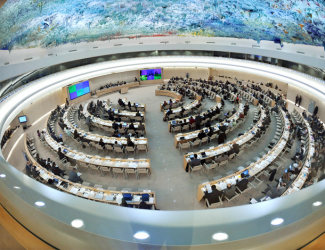
Jean-Marc Ferré | Flickr (CC BY-NC-ND 2.0)
A general view of participants at the 16th session of the Human Rights Council in Geneva, Switzerland.

Special Focus

AWID is an international, feminist, membership organisation committed to achieving gender equality, sustainable development and women’s human rights

Human Rights Council (HRC)

The Human Rights Council (HRC) is the key intergovernmental body within the United Nations system responsible for the promotion and protection of all human rights around the globe. It holds three regular sessions a year: in March, June and September. The Office of the UN High Commissioner for Human Rights (OHCHR) is the secretariat for the HRC.

The HRC works by:

  • Debating and passing resolutions on global human rights issues and human rights situations in particular countries

  • Examining complaints from victims of human rights violations or activist organizations on behalf of victims of human rights violations

  • Appointing independent experts (known as “Special Procedures”) to review human rights violations in specific countries and examine and further global human rights issues

  • Engaging in discussions with experts and governments on human rights issues

  • Assessing the human rights records of all UN Member States every four and a half years through the Universal Periodic Review

Learn more about the HRC


AWID works with feminist, progressive and human rights partners to share key knowledge, convene civil society dialogues and events, and influence negotiations and outcomes of the session.

With our partners, our work will:

◾️ Monitor, track and analyze anti-rights actors, discourses and strategies and their impact on resolutions

◾️ Raise awareness of the findings of the 2017 and 2021 OURs Trends Reports.

◾️Support the work of feminist UN experts in the face of backlash and pressure

◾️Advocate for state accountability
 
◾️ Work with feminist movements and civil society organizations to advance rights related to gender and sexuality.
 

Related Content

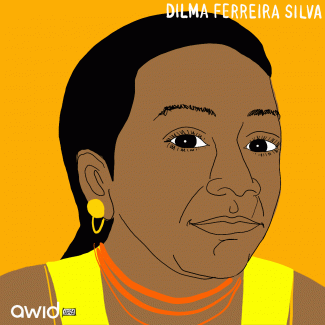
Dilma Ferreira Silva

Dilma Ferreira Silva was a leading Amazonian rights activist who fought for decades for the rights of people affected by dams.

She herself was among the 32,000 people displaced by the Tucuruí, a mega-hydroelectric power plant, built in Brazil during the 1964-1985 military dictatorship.

In 2005 Dilma was invited to join the Movement of Dam-Affected Peoples in Brazil (MAB), and in 2006 she formed the women’s collective, eventually becoming regional coordinator of the movement.

In speaking about her activism, her colleagues commented:

“She stood out very fast because she was always very fearless in the struggle.” 

Dilma lived in the rural settlement of Salvador Allende,50 kilometers from Tucuruí, and dedicated her life to better protect communities and the land affected by the construction of mega projects. She was especially concerned with the gendered impacts of such projects and advocated for women’s rights.

At a national MAB meeting in 2011, Dilma spoke to women affected by the dams, saying:

“We are the real Marias, warriors, fighters who are there, facing the challenge of daily struggle”.

In the following years, Dilma organized grassroots MAD groups and worked with the community to form farming cooperatives that created a better distribution of food for the community. They improved the commercialization of fishing, and developed a cistern project for safe drinking water. She was also an advocate for farmers whose lands were being coveted by ‘grileiros’ (land grabbers). 

On 22nd March 2019, at the age of 48, Dilma, her husband and their friend were all brutally murdered. The three killings came as part of a wave of violence in the Amazon against the Movimento dos Trabalhadores Sem Terra (translates as ‘landless workers’ movement’), environmental and indigenous activists. 
Является ли мое участие конфиденциальным?

Да. Ваши ответы будут удалены по окончании обработки и анализа данных и будут использованы исключительно в исследовательских целях. Данные НИКОГДА не будут переданы за пределы AWID и будут обрабатываться только сотрудниками AWID и консультантками(-тами), работающими с нами над проектом «Где деньги?». Для нас ваша конфиденциальность и безопасность– приоритет. С нашей политикой конфиденциальности можно подробно ознакомиться здесь.

Impression collective d’amour | Small Snippet FR

Impression collective d’amour

« Si on peut hériter de traumatismes, peut-on aussi hériter d’une impression en lien avec l’amour? »

Lire plus

Sylvia Rivera

Sylvia Rivera fue activista por los derechos civiles, travesti y trabajadora sexual.

Conocida como la Drag Queen de color de Nueva York, Sylvia fue feroz e incansable en su voluntad por cambiar las cosas, y en su defensa de  quienes quedaron marginadxs y excluidxs cuando el movimiento por los "derechos de la comunidad gay"  se volvió predominante en los Estados Unidos, a principios de los 70.

En 1973, durante un conocido discurso por el día de Christopher Street, Sylvia gritó en medio de la multitud de integrantes de la comunidad LGBT:

"Todos ustedes me dicen, anda y esconde la cola entre las patas.
No voy a seguir aguantando esta mierda.
Me han golpeado.
Me han roto la nariz.
Me han metido en la cárcel.
He perdido mi trabajo.
He perdido mi departamento
por la liberación gay, ¿y todos ustedes me tratan así?
¿Qué carajo les pasa a todos ustedes?
¡Piensen en eso!"

En 1969, a la edad de 17 años, Sylvia participó en los emblemáticos disturbios de Stonewall, al lanzar, presuntamente, el segundo cóctel molotov para protestar por la redada policial en este bar gay de Manhattan. Siguió siendo una figura central en los levantamientos posteriores, organizando mítines y luchando contra la brutalidad policial.

En 1970, Sylvia trabajó junto con Marsha P. Johnson para establecer Street Transvestite Action Revolutionaries [Acción Travesti Callejera Revolucionaria] (S.T.A.R., por sus siglas en inglés), un colectivo político y una organización que establecería proyectos de apoyo mutuo para las personas trans que vivían en la calle, aquellxs que luchaban contra la drogadicción, las que estaban encarceladas y, en particular, para las personas trans de color  que vivían en la pobreza.

Desafiante de las etiquetas, Silvia vivió la vida de una manera que retaba a las personas del movimiento de liberación gay a pensar de manera diferente. Ella dijo:

"Me fui de casa a los 10 años, en 1961.  Hice la calle en la 42. El inicio de los años 60 no era un buen momento para lxs drag queens, los chicos afeminados o los chicos que usaban maquillaje como nosotrxs. En ese entonces nos golpeaba la policía, y todo el mundo. Yo no salí realmente como drag queen hasta finales de los 60, cuando se arrestaba a lxs drag queens, qué degradación había. Recuerdo que la primera vez que me arrestaron, ni siquiera estaba vestida totalmente en drag. Estaba caminando y los policías me arrebataron de la calle. La gente ahora quiere llamarme lesbiana porque estoy con Julia, y yo digo: "No. Soy sólo yo. No soy lesbiana". Estoy cansada de que me etiqueten. Ni siquiera me gusta la etiqueta transgénero. Estoy cansada de vivir con etiquetas. Sólo quiero ser quien soy. Soy Sylvia Rivera. 

A través de su activismo y su coraje, Sylvia ofreció un espejo que reflejaba todo lo que estaba mal en la sociedad, pero también la posibilidad de transformación. Sylvia nació en 1951 y falleció en 2002.

Desejam recolher quantas respostas ao questionário?

O nosso objetivo é alcançar um total de 2000 respostas, quase o dobro do último questionário WITM em 2011.

Clone of Crear | Résister | Transform: A Walkthrough of the Festival! - smaller snippet

Ghiwa-Sayegh-visite guidee du festiva

Crear | Résister | Transform : 
visite guidée du Festival

Alors que le capitalisme hétéropatriarcal s’acharne à nous contraindre au consumérisme et à la conformité, nous constatons que nos luttes sont cloisonnées et séparées par des frontières aussi bien physiques que virtuelles.

Lire plus

Cynthia Cockburn

Cynthia Cockburn était une sociologue, écrivaine, universitaire, photographe et militante pour la paix féministe.

Elle a étudié les aspects genrés de la violence et du conflit et fait d’importantes contributions au mouvement pacifiste en explorant les thèmes de la masculinité et de la violence, ainsi que par son activisme local et international.

Ayant introduit une analyse féministe aux questions de militarisation et de guerre, Cynthia figurait parmi les universitaires dont les écrits et analyses illustraient la manière dont la violence basée sur le genre joue un rôle essentiel dans la perpétuation de la guerre. Travaillant en étroite collaboration avec des activistes pacifistes dans des pays en conflit, ses conclusions portaient sur des contextes aussi divers que l’Irlande du Nord, la Bosnie-Herzégovine, Israël et la Palestine, la Corée du Sud, le Japon, l’Espagne et le Royaume-Uni. Sa recherche et ses écrits universitaires ont permis d’éclairer le fait que la violence soit vécue selon un continuum de temps et d’échelle, et perçue très différemment lorsque l’on y applique le prisme du genre.

Elle disait que « [l]e genre nous aide à voir la continuité, la connexion entre les évènements de violence ».

Cynthia a pu mettre ses recherches en pratique grâce à son activisme local et international auprès de mouvements pour la démilitarisation, le désarmement et la paix. Elle a aidé à lancer le camp de femmes pour la paix de Greenham Common, qui prônait le désarmement nucléaire universel en Grande-Bretagne, ainsi que participé à la mise en place de la branche londonienne des Women in Black. Au fil des ans, Cynthia a organisé et participé à des veillées hebdomadaires locales et à la chorale politique Raised Voices, interprétant et écrivant certaines des paroles des chansons. Elle fut également active au sein du groupe Women’s International League for Peace and Freedom (WILPF), du Forum des socialistes féministes européennes et de Women Against Fundamentalism.

« Cynthia émettait une lumière féministe, tissait les communautés féministes entre elles, entonnait des chants de paix, écoutait, écoutait, écoutait, observait les oiseaux – et suspendait le flot de circulation. Je lui serai toujours reconnaissante et redevable, l’« autre » Cynthia. » – Cynthia Enloe

Cynthia est née en juillet 1934 et s’est éteinte en septembre 2019, à l’âge de 85 ans.

Snippet - WITM Languages - EN

AWID en 2014: Fortaleciendo la organización de las mujeres por sus derechos en todo el mundo

Clone of #6 - Sexting like a feminist Tweets Snippet FR

Toujours être volontaire à explorer de nouvelles expériences!

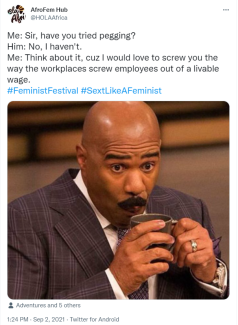
Image of a tweet with the photo of American tv Host Steve Harvey. Text says - Me: Sir, have you tried pegging? Him: No, I haven't. Me: Think about it, cuz I would love to screw you the way the workplaces screw employees out of a livable wage.

Moi : Monsieur, avez-vous essayé le pegging?
Lui : Non, madame.
Moi : Pensez-y, parce que j’aimerais bien vous baiser comme ces entreprises qui baisent leur personnel pour un salaire à peine minimum.

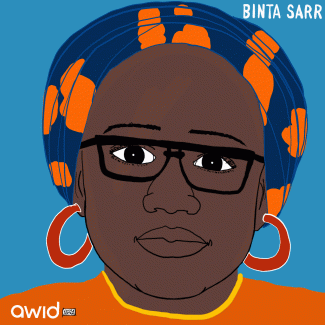
Binta Sarr

Binta Sarr was an activist for social, economic, cultural and political justice, and a hydraulic engineer in Senegal. After 13 years in civil service, she left this path to work with rural and marginalized women. 

Out of this engagement grew the Association for the Advancement of Senegalese Women (APROFES), a grassroots movement and organization Binta founded in 1987. One of her main approaches was leadership training, relating not only to economic activities but also to women's rights and access to positions of decision-making. 

“Grassroots populations must organize, mobilize, assume citizen control and demand democratic governance in all sectors of public space. The priority of social movements must go beyond the fight against poverty and must be focused on articulated and coherent development programs in line with human rights principles, while taking into account their needs and concerns both at the national and sub-regional levels and from a perspective of African and global integration.” - Binta Sarr

Rooted in Binta’s conviction that fundamental change in women’s status requires transformation in male attitudes, APROFES took an interdisciplinary approach, using radio, seminars and popular theatre, as well as providing innovative public education and cultural support for awareness-raising actions. Its popular theatre troupe performed original pieces on the caste system in Senegal, alcoholism, and conjugal violence. Binta and her team also looked at the crucial connection between the community and the broader world.

“For APROFES, it is a question of studying and taking into account the interactions between the micro and the macro, the local and the global and also, the different facets of development. From slavery to colonization, neocolonialism and the commodification of human development, most of the resources of Africa and the Third World (oil, gold, minerals and other natural resources) are still under the control of financial cartels and other multinationals that dominate this globalized world.” - Binta Sarr

Binta was one of the founding members of the female section of the Cultural and Sports Association Magg Daan. She received commendations from the Regional Governor and the Minister of Hydrology for her "devotion to rural people."

Born in 1954 in Guiguineo, a small rural town, Binta passed away in September 2019.


Tributes:

“The loss is immeasurable, the pain is heavy and deep but we will resist so as not to mourn Binta; we will not mourn Binta, we will keep the image of her broad smile in all circumstances, to resist and be inspired by her, maintain, consolidate and develop her work…” - Aprofes Facebook page, September 24, 2019

"Farewell Binta! We believe your immense heritage will be preserved." - Elimane FALL, president of ACS Magg-Daan 
 

What Our Members Say - En

What Our Members Say

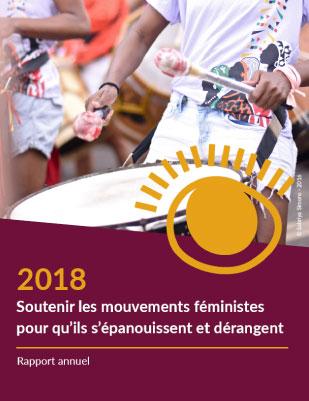
2018 : Soutenir les mouvements féministes pour qu'ils s'épanouïssent et dérangent

Ce rapport retrace et célèbre la première année du nouveau plan stratégique de l'AWID, et fait un retour en arrière sur nos premiers pas vers les objectifs visés, à savoir soutenir les mouvements féministes pour qu'ils prospèrent, remettent en question les programmes anti-droits et co-créent des réalités féministes.

Télécharger le rapport annuel 2018


Nous avons travaillé avec les féministes pour bousculer les programmes anti-droits et avons remporté d'importantes victoires au sein du système des Nations Unies avec l’inclusion, dans un certain nombre de résolutions, de termes novateurs sur la discrimination structurelle, les droits sexuels et les obligations des États. Oui, le système multilatéral est en crise et a besoin d'être sérieusement renforcé, mais ces victoires sont importantes car elles contribuent à la légitimité des revendications féministes et fournissent aux mouvements féministes davantage de points de pression et d'élan pour faire avancer nos programmes.

Nous avons essayé et testé différentes façons d’acquérir des connaissances avec les mouvements féministes à travers des webinaires, des podcasts et des discussions ‘en direct’. Nous avons développé des guides d’animation avec des éducateurs et éducatrices populaires pour récupérer des connaissances dans l'intérêt de la justice sociale et la justice de genre, même sur un sujet aussi opaque en apparence que les flux financiers illicites. Nous avons sollicité des blogs et des opinions sur la façon dont les groupes féministes se financent et se ressourcent, ainsi que fait la lumière sur les menaces qui pèsent sur nos systèmes de droits humains. 

Au sein de l’AWID, nous avons pratiqué le leadership partagé et tiré des leçons de cette approche, et narré le récit des épreuves et des tribulations propres à la codirection d’une organisation mondiale virtuelle. Nous n’avons pas de réponse définitive quant à la forme que revêt le leadership féministe, mais un an plus tard, nous avons conscience que cet engagement continu envers l’apprentissage et l’expérimentation nous a permis de continuer à bâtir une organisation à laquelle nous sommes tou-te-s ravi-e-s de contribuer. 

À l’heure où nous revenons sur l’année qui vient de s’écouler, nous souhaitons remercier tou-te-s nos ami-e-s et allié-e-s, collègues et camarades qui ont donné de leur temps et partagé avec nous leur richesse de savoir et de sagesse. Nous souhaitons remercier nos membres qui ont contribué à l’élaboration de notre plan stratégique et se sont joint-e-s à nous pour formuler des revendications féministes. Ce travail ne pourrait être réalisé sans vous. 

Télécharger le rapport annuel 2018

Colectivo Morivivi Snippet ES

Colectivo Morivivi

Moriviví es un colectivo de jóvenes artistas mujeres que trabajan en arte público desde abril de 2013. Con sede en Puerto Rico, hemos obtenido reconocimiento por la creación de murales y de arte comunitario.

Visitar la exposición

Laurie Carlos

Laurie Carlos fue una actriz, directora, bailarina, dramaturga y poeta estadounidense, una artista y visionaria extraordinaria que tenía un poderoso don para hacer surgir el arte en otras personas.

«Laurie entraba en una habitación (cualquier habitación/todas las habitaciones ) con  clarividencia arremolinada, con genio artístico, rigor corporizado, con un realismo feroz— y con la determinación de ser libre... y de liberar a otrxs. Una hacedora de magia. Una vidente. Alguien que cambiaba de formas. Laurie me dijo una vez que entraba en los cuerpos de las personas para descubrir qué necesitaban.» - Sharon Bridgforth

Combinaba estilos de actuación tales como gestos rítmicos y texto. Laurie era mentora de nuevxs actorxs, performers y escritorxs, y ayudaba a difundir su trabajo a través de «Naked Stages», una beca para artistas emergentes. Integraba el Penumbra Theater, con el que colaboraba mediante guiones que produjeran identificaciones, a fin de «traer más voces femeninas al teatro». Laurie integraba también Urban Bush Women, una compañía de danza contemporánea prestigiosa que relata historias sobre mujeres de la diáspora africana.

En 1976, como Lady in Blue, hizo su debut en Broadway, en la producción original galardonada del drama poético de Ntozake Shange For colored girls who have considered suicide / when the rainbow is enuf. La obra de Laurie incluye White Chocolate, The Cooking Show y Organdy Falsetto.

«Cuento las historias en el movimiento (las danzas internas que surgen espontáneamente, como en la vida), la música y el texto. Si escribo una línea, no necesariamente tiene que ser una línea que es hablada; puede ser una línea que es movida. Una línea a partir de la cual se crea música. El gesto se convierte en la oración. Gran parte de quienes somos como mujeres, como personas, tiene que ver con los gestos que hacemos entre nosotrxs todo el tiempo, y en particular, durante momentos emotivos. El gesto se convierte en una oración o una declaración de hechos. Si pongo en un guión “cuatro gestos”, eso no quiere decir que no estoy diciendo nada; significa que lo he abierto para que algo sea dicho físicamente.» - Laurie Carlos

Laurie nació y creció en la ciudad de Nueva York, trabajó y vivió en Twin Cities. Falleció el 29 de diciembre de 2016 a la edad de 67 años, luego de una batalla contra el cáncer de colon.


Tributos:

 «Creo que esa era exactamente la intención de Laurie. Salvarnos. De la mediocridad. Del ego. De la pereza. De la producción de arte a medias. De estar paralizadxs por el miedo. Laurie quería ayudarnos a Brillar plenamente. En nuestra producción artística. En nuestras Vidas.» - Sharon Bridgforth para Pillsbury House Theatre

«Nadie que conociera a Laurie dejaría de definirla como una persona original. Era su propia persona. Era su propia persona, su propia artista; ponía en escena el mundo tal como lo conocía, con verdadero estilo y comprensión, y vivía su arte.» - Lou Bellamy, fundador de Penumbra Theater Company, para Star Tribune

Leer un tributo completo de Sharon Bridgforth (solo en ingles)

Snippet - CSW69 Image - ES