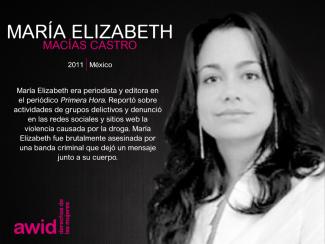
Maria Elizabeth Macias Castro
WHRDs are self-identified women and lesbian, bisexual, transgender, queer and intersex (LBTQI) people and others who defend rights and are subject to gender-specific risks and threats due to their human rights work and/or as a direct consequence of their gender identity or sexual orientation.
WHRDs are subject to systematic violence and discrimination due to their identities and unyielding struggles for rights, equality and justice.
The WHRD Program collaborates with international and regional partners as well as the AWID membership to raise awareness about these risks and threats, advocate for feminist and holistic measures of protection and safety, and actively promote a culture of self-care and collective well being in our movements.
WHRDs are exposed to the same types of risks that all other defenders who defend human rights, communities, and the environment face. However, they are also exposed to gender-based violence and gender-specific risks because they challenge existing gender norms within their communities and societies.
We work collaboratively with international and regional networks and our membership
We aim to contribute to a safer world for WHRDs, their families and communities. We believe that action for rights and justice should not put WHRDs at risk; it should be appreciated and celebrated.
Promoting collaboration and coordination among human rights and women’s rights organizations at the international level to strengthen responses concerning safety and wellbeing of WHRDs.
Supporting regional networks of WHRDs and their organizations, such as the Mesoamerican Initiative for WHRDs and the WHRD Middle East and North Africa Coalition, in promoting and strengthening collective action for protection - emphasizing the establishment of solidarity and protection networks, the promotion of self-care, and advocacy and mobilization for the safety of WHRDs;
Increasing the visibility and recognition of WHRDs and their struggles, as well as the risks that they encounter by documenting the attacks that they face, and researching, producing, and disseminating information on their struggles, strategies, and challenges:
Mobilizing urgent responses of international solidarity for WHRDs at risk through our international and regional networks, and our active membership.
Facebook: @AWIDWomensRights
Instagram: @awidwomensrights
Twitter FR: @awid_fr
LinkedIn: Association for Women's Rights in Development (AWID)
Obtén más información sobre los próximos eventos de la CSW69 que AWID está coorganizando
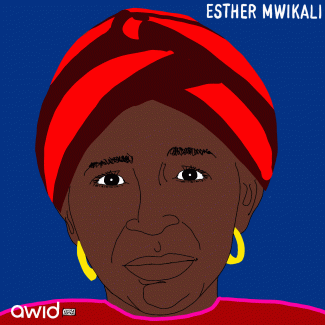
Esther Mwikali’s home was in Mithini village, Murang’a County, Kenya. A prominent and valued land rights activist, she looked into abuses against squatters who are living on land claimed by tycoons. The investigation Esther was part of also involved land rights’ violations in Makuyu by powerful individuals.
After failing to attend a village meeting, a search party went looking for Esther. On 27 August 2019, two days after her disappearance, her body was found on a farm near her homestead, displaying signs of torture. She was brutally murdered.
“Esther was renowned for her work to prevent community members being evicted from land claimed by tycoons. Local activists had no doubt her murder was related to the area’s ongoing land struggles, a tragic reminder of the alarming regularity with which extra-judicial killings are routinely carried out in Kenya,” - Global Witness Report, July 2020
“We associate Mwikali’s death with land struggles around here. We are asking the Government to investigate the matter without delay.” - James Mburu, spokesperson for the squatters
“Action should be taken on individuals who are alleged to have threatened the squatters including Mwikali's family.” - Alice Karanja, National Coalition of Human Rights Defenders
“The impact of her work and tenacity will remain alive in Kenya for decades. CJGEA consoles with the bereaved and it calls for justice.” - Center for Justice and Governmental Action (CJGEA) Press Release, 13 September 2019
All our annual reports are accessible online.
✉️ Requiere inscripción previa. Regístrate aquí
📅 Miércoles 12 de marzo de 2025
🕒 De 05:00 a 07:00 p.m., EST
🏢 Chef's Kitchen Loft with Terrace, 216 East 45th St 13th Floor New York
Organizan: Women Enabled International y AWID
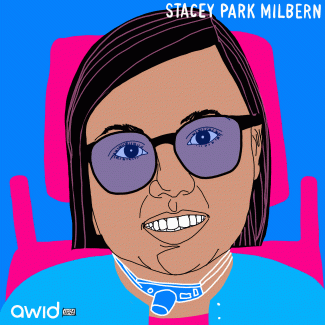
"No sé mucho sobre la espiritualidad o lo que sucede cuando morimos, pero mi vida de coreana crip queer me hace pensar que nuestros cuerpos terrenales son sólo una fracción de lo que somos, y no considerar a nuestros antepasadxs es quedarse con solo un atisbo de lo que somos". - Stacey Park Milbern
Stacey, junto con algunxs amigxs, co-creó el Club de Cultura de Justicia para la Discapacidad, un grupo dedicado a apoyar a varias comunidades, especialmente aquellas más vulnerables, que, entre otras cosas, está ayudando a las personas sin hogar a acceder a recursos durante la pandemia del COVID-19.
También fue coproductora de una campaña con mucho impacto para el documental de Netflix "Crip Camp", integrante de la junta directiva de la Fundación WITH, y dirigió organizaciones a nivel local, estatal y nacional. Stacey escribió además de manera hermosa y poderosa:
"Mis antepasadxs son personas forzosamente separadas de sus amores a causa de la guerra y el desplazamiento. Es gracias a ellxs que hoy conozco el poder de construir un hogar con lo que tienes, dondequiera que estés, con quien quiera que estés. Mis antepasadxs son queers que vivieron en el sur de América. Es gracias a ellxs que entiendo la importancia de las relaciones, del lugar y de vivir la vida al máximo, aunque sea peligroso. Todxs mis antepasadxs conocen el anhelo. El anhelo es a menudo nuestro lugar de conexión..." - Stacey Park Milbern
Stacey nació en Seúl, Corea, y creció en Carolina del Norte, para después continuar con su viaje en el área de la bahía de San Francisco. Stacey falleció por complicaciones de una cirugía en su cumpleaños número 33, el 19 de mayo de 2020.
Para leer un ensayo de Stacey Park Milbern (en inglés)
Para escuchar una entrevista con Stacey Park Milbern (en inglés)
#StaceyTaughtUs: Record your story for the Disability Visibility Project (en inglés)
"Ella fue, como mucha gente diría, una líder nata. En cierta medida, ella lo abarcó todo. ¿Sabes? Ella supo liderar desde la primera línea, desde el medio y también desde atrás. Era capaz de hacer todo eso de alguna manera." - Andraéa LaVant, activista por los derechos de las personas con discapacidad.
"Qué golpe perder a Stacey cuando nuestras comunidades necesitan de su liderazgo más que nunca, y en un momento en que su fuerza, perspicacia y agallas estaban recibiendo un mayor reconocimiento, más allá de los círculos de las personas con discapacidad, y le ofrecían una plataforma mayor para avanzar con el trabajo de su vida... No tendremos la suerte de aprender hasta dónde su carismático liderazgo nos habría llevado. Pero, sin ningún tipo de dudas: Lo que Stacey nos dio, en un tiempo relativamente corto, continuará beneficiando a otrxs en los próximos años". - Fondo de Educación y Defensa de los Derechos de las Personas con Discapacidad (DREDF, por sus siglas en inglés).
✉️ Sur inscription pour les grands groupes. Espace ouvert pour les petits groupes. Inscrivez-vous ici
📅 Mercredi 12 mars 2025
🕒 14.00h-16.00h EST
🏢 Chef's Kitchen Loft with Terrace, 216 East 45th St 13th Floor, New York
Organisé par : AWID
Premier Dialogue de haut niveau sur le financement du développement, 29-30 octobre 2003.
Les dialogues de haut niveau de l’Assemble générale des Nations Unies sur le financement du développement, tenus tous les deux ans, sont l’un des mécanismes de suivi de la Conférence de Monterrey. À la suite de ce premier dialogue, huit tables rondes ont été organisées autour de différentes questions comprenant les subventions agricoles, le commerce, l’allègement de la dette et le financement des OMD. Toutes les discussions se concentraient sur les manières de faire face aux obstacles structurels qui pesaient sur ces questions et défavorisaient les nations « en développement ».
D'autres mécanismes de suivi de la Conférence de Monterrey :
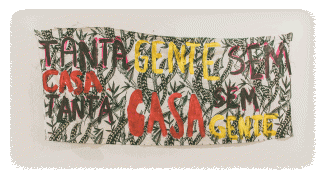
Née à Bahia, dans le nord-est du Brésil, Carmen est une immigrante, militante sociale et mère de 8 enfants.
Carmen a connu l'itinérance à l'âge de 35 ans, après avoir émigré seule à São Paulo. Cela l'a amenée à devenir une ardente défenseuse des communautés vulnérables, marginalisées et invisibles les plus touchées par la crise du logement. Elle est finalement devenue l'une des fondatrices de MSTC en 2000.
En tant qu'organisatrice politique visionnaire et actuelle dirigeante du MSTC, le travail de Carmen a révélé la crise du logement de la ville de São Paulo et inspiré d'autres personnes sur différentes façons d'organiser et de gérer les occupations.
Carmen a été fermement à l'avant-garde de diverses occupations. L'une d'elles est l’Ocupação 9 de Julho, qui sert désormais de scène à la démocratie directe et d'espace où chacun·e peut être soigné·e, entendu·e, apprécié·e et travailler ensemble.
Carmen a longtemps été célébrée pour son audace à redonner vie à des bâtiments abandonnés au cœur de São Paulo.
Pour en savoir plus sur sa vie, vous pouvez la suivre sur Instagram!
In response to these challenges, we collaborated with Impactmapper to co-create a comprehensive resource that combines two powerful tools to strengthen the funding ecosystem for social justice movements.
The Fifth High- Level Dialogue on Financing for Development, 7 – 8 December 2011, marked the beginning of the Post 2015 development agenda discussions, and the link to financing for development. The conference gave a special focus to increasing aid to finance the MDG’s. In his closing remarks, the Secretary General called on members to begin to consider the post-2015 development framework.
 |
Human and ethnic-territorial rights Ensuring the defense of human rights and Nature’s rights through alliance-building with local, national, regional and global actors and organizations. |
 |
Sustainable development Ensuring all economic, cultural and environmental activities contribute to sustainable development, food security and income generation, while respecting the self-determination and self-government of Afro-descendant communities. |
 |
Education and training Carrying out training for women and empowering them to carry out women’s rights advocacy in different political, social and economic spaces. For more information, see here! |