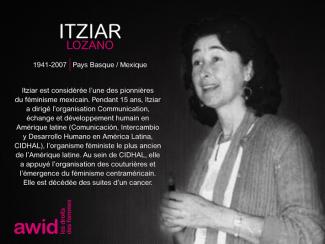
Itziar Lozano
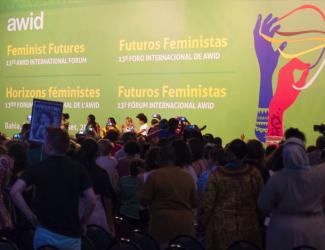
In September 2016, the 13th AWID international Forum brought together in Brazil over 1800 feminists and women’s rights advocates in a spirit of resistance and resilience.
This section highlights the gains, learnings and resources that came out of our rich conversations. We invite you to explore, share and comment!
One of the key takeaways from the 2016 Forum was the need to broaden and deepen our cross-movement work to address rising fascisms, fundamentalisms, corporate greed and climate change.
With this in mind, we have been working with multiple allies to grow these seeds of resistance:
And through our next strategic plan and Forum process, we are committed to keep developing ideas and deepen the learnings ignited at the 2016 Forum.
AWID Forums started in 1983, in Washington DC. Since then, the event has grown to become many things to many peoples: an iterative process of sharpening our analyses, vision and actions; a watershed moment that reinvigorates participants’ feminisms and energizes their organizing; and a political home for women human rights defenders to find sanctuary and solidarity.
Elle est ouverte jusqu’à la fin août 2024. Merci d’y répondre avant cette date butoir, afin que vos réponses soient incluses dans l’analyse.
A war that exists only for those of us living in this territory.
I live in a country no one understands, which few can really see, where various realities co-exist, and where the truth is murdered time and again.
I live in a country where one has to pay for the audacity of thinking for oneself, for taking on the challenge of seeing life another way.
I live in a country of women who have had to invent and reinvent, time and again, how they live and how to get by.
I live in Venezuela, in a time of an unusual and extraordinary threat.
Since 2012 my country has been subjected to an unconventional war. There are no defined armies or fire power. Their objective is to dislocate and distort the economy, affecting all households, daily life, the capacity of a people to dream and build a different kind of politics, an alternative to the patriarchal, bourgeois, capitalist democracy.
Venezuelan women are the primary victims of this economic war. Women who historically and culturally are responsible for providing care, are the most affected and in demand. However, in these years of economic and financial embargo, Venezuelan women have gone from being victims to the protagonists on the front lines defending our territory.
Battles are fought from the barrios, kitchens, and small gardens. We defend the right of girls and boys to go to school, and to be given something so simple as some arepas for breakfast.
Arepas are a kind of corn cake that can be fried, roasted or baked and served sweet or savoury as a side or main dish. It is a staple in the diet of all Venezuelans.
In Venezuela, arepas mean culture, family, food sovereignty, childhood nostalgia, the expert hands of grandmothers molding little balls, the warmth that comforts you when recovering from illness.
Arepas connect us as a people with the pre-Colombian cultures of corn, a resistance that has endured for more than five centuries. They are the Caribbean expressed differently on firm ground.
They are an act of resistance.
When my mother was a girl, they would start grinding the dry corn early in the morning to make arepas. The women would get up and put the kernels of corn in wooden mortars and pound it with heavy mallets to separate the shells. Then they would boil, soak, and grind the corn to make dough, and finally they would mold it into round arepas. The process would take hours and demand a lot of physical effort.
In the mid-20th century a Venezuelan company industrialized the production of corn meal. For an entire generation that seemed like an act of liberation, since there was now a flour that you could simply add water to and have hot arepas in 45 minutes time.
But that also meant that the same generation would lose the traditional knowledge on how to make them from scratch. My grandmother was an expert arepa maker, my mother saw it as a girl, and for me the corn meal came pre-packaged.
In the war with no military, the pre-cooked corn meal came to be wielded as an instrument of war by the same company that invented it, which was not so Venezuelan anymore: today the Polar group of companies is transnational.
We women began to recuperate our knowledge by talking with the eldest among us. We searched in the back of the closets for our grandmothers’ grinders, the ones we hadn’t thrown away out of affection. Some families still prepared the corn in the traditional way for important occasions. In some towns there were still communal grinding stations which had been preserved as part of local history or because small family businesses refused to die. All of these forms of cultural resistance were activated, and we even went so far as to invent new arepas.
Today we know that in order to resist we cannot depend on one food staple. Although corn arepas continue to be everyone’s favourite, we have invented recipes for arepas made of sweet potato, cassava, squash, and celery root.
We have learned that we can use almost any root vegetable to make arepas. Cooperative businesses have developed semi-industrial processes to make pre-cooked corn meal. In other words, we have recuperated our arepas and their preparation as a cultural good that belongs to all.
My artivism aims to decolonize our senses in everyday life. I like to create spaces that communicate how we weave together our different struggles, and that render visible dissident (re)existences, other possible worlds, and living bodies here in the SOUTH.
As we continue to fight in our struggles, let us remember how essential it is that we support each other, believe each other, and love ourselves and our sisters. When this system fucks us over, we must take time to look after our (physical and mental) health, that of our sisters, and to understand that each one of us carries unique stories, making us fighters in resist

These portraits are inspired by the voices of resistance and protest movements in Latin America, especially by the key role that feminised bodies play in these struggles. It is a tribute to the grassroots feminist movements in resistance.
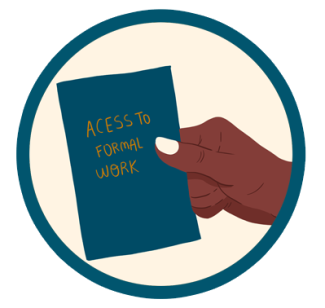
Only 18% of trans and travesti people in Argentina have access to formal work.
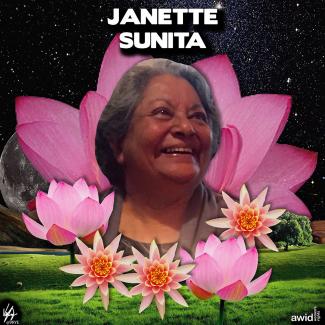
Originaire d'Inde, Janette était une personne formidable, fougueuse, bienveillante et aimante.
Son intolérance à l’égard de l’injustice et sa ferme volonté de défendre les droits de toutes les personnes l’ont amenée à travailler pour TARSHI (une ONG qui travaille sur la sexualité et la santé sexuelle et reproductive) pendant plus de 15 ans. Janette a géré et dirigé avec compétence les aspects financiers, les ressources humaines et les aspects opérationnels de TARSHI, naviguant adroitement dans la bureaucratie labyrinthique à laquelle sont soumises les ONG indiennes.
Son équipe se souvient « elle assurait nos arrières pour que nous puissions naviguer en eaux libres. Femme aux multiples talents, Janette nous a non seulement aidés à acquérir nos propres bureaux, mais elles les a également aménagés pour leur utilisation optimale. Elle aimait les voyages et les animaux et s'intéressait à la thérapie assistée par les animaux ».
Ressources en soutien aux mouvements féministes, aux décideur·euse·s et aux allié·e·s pour résister aux tendances antidroits.
Опрос предназначен для групп, организаций и движений, работающих исключительно или главным образом по вопросам защиты прав женщин, ЛГБТКИ+, гендерной справедливости во всех контекстах, на всех уровнях и во всех регионах. Если одно из этих направлений является основным видом деятельности вашей группы, коллектива, сети или любого другого типа организации – независимо от того, зарегистрирована она или нет, недавно создана или существует уже давно, мы приглашаем вас принять участие в этом опросе.

* На данном этапе мы не ожидаем ответов от частных лиц или женских и феминистских фондов.
Узнайте больше об опросе:
загляните в часто задаваемые вопросы
Estas obras son un trabajo colaborativo de fotografías e ilustraciones realizadas por Siphumeze y Katia durante el confinamiento. Muestran narrativas negras queer de sexo y placer, bondage, sexo seguro, juguetes, salud mental y sexo, y mucho más. Fueron creadas para acompañar la antología Touch.





From Peacebuild to the Canadian Feminist Alliance for International Action, Amnesty International, and the Canadian Centre for Policy Alternatives (CCPA), Kate had a lifelong passion for women’s rights and gender equality and dedicated her career to fighting inequality and making the world a more compassionate place.
Kate was a member of the Coordinating Committee of Social Watch and a contributor to the Canadian National Social Watch reports. As a Senior Researcher at the CCPA, Kate received national acclaim for researching, writing, and producing the annual “The Best and Worst Places to be a Woman in Canada” report.
Kate died peacefully surrounded by her family, following a three-year battle with colon cancer. She is described by loved ones as a “Funny, Fearless, Unapologetically Feminist.”


Para dar ênfase à complexidade do financiamento de várias formas de organização feminista;
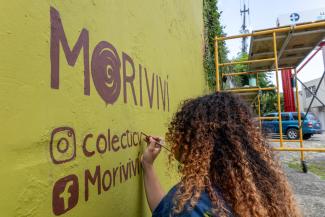
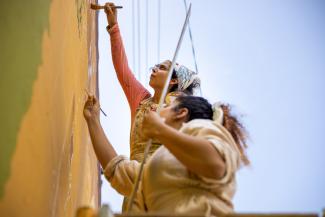
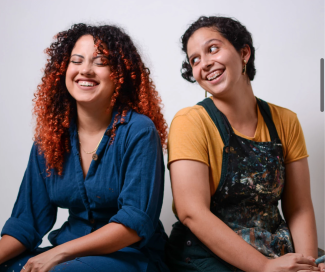
Colectivo Moriviví est un collectif artistique de femmes. Notre production artistique comprend du muralisme, du muralisme communautaire et des performances/actions de manifestation. Notre travail consiste à démocratiser l'art et à amener les récits des communautés portoricaines dans la sphère publique afin de créer des espaces où ils seront validés. Nous croyons qu’à travers l'artivisme, nous pouvons promouvoir la sensibilisation aux questions sociales et renforcer notre mémoire collective.
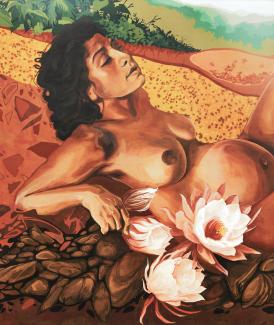
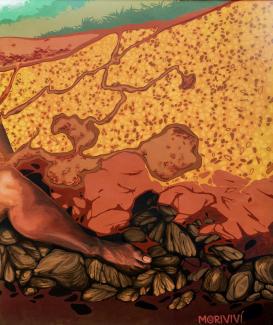
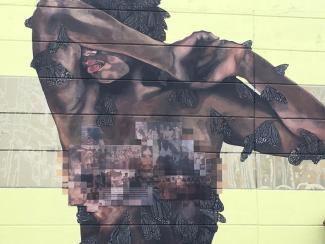
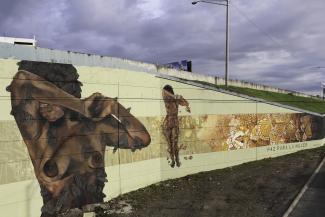
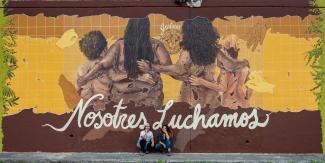
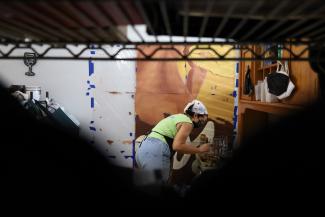
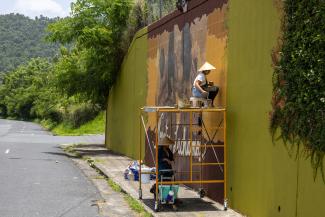
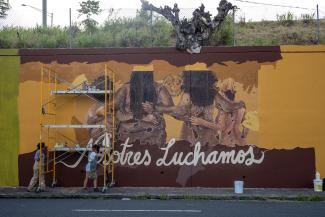
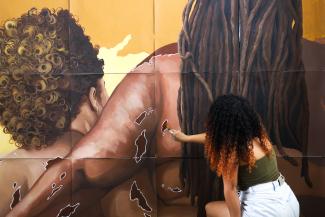
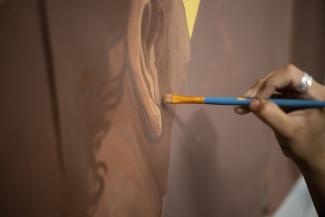
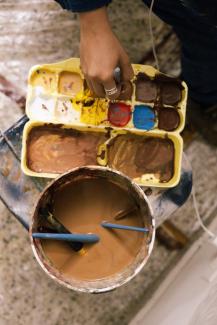
Dans le cadre de sa participation au Groupe de Travail d’Artistes d'AWID, le Colectivo Moriviví a réuni un groupe divers de membres, partenaires et personnel pour faciliter un processus collaboratif visant à imaginer, documenter et déterminer le contenu d'une fresque communautaire par le biais d'un processus de co-création en plusieurs étapes. Le projet a commencé par une conceptualisation à distance avec des féministes de différentes régions du monde réuni·e·s par l'AWID, avant d'évoluer vers sa re-contextualisation et sa réalisation à Porto Rico. Nous avons eu l'honneur de bénéficier de la contribution des artistes locaux·ales Las Nietas de Nonó(@lasnietasdenono), de la participation des femmes locales à la session de peinture communautaire, du soutien logistique de la municipalité de Caguas et du soutien supplémentaire du FRIDA | The Young Feminist Fund.
La fresque explore la transcendance des frontières en présentant les corps tels des cartes, dans une étreinte qui met en évidence l'intersection des différentes manifestations, pratiques et réalités féministes.
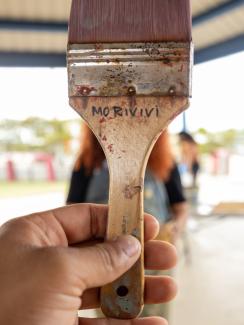
Nous remercions également Kelvin Rodríguez, qui a documenté et capturé les différentes étapes de ce projet à Porto Rico :
La Coopérative Textile Nadia Echazú porte le nom d'une pionnière dans la lutte pour les droits des personnes trans en Argentine. À bien des égards, le travail de la coopérative célèbre la vie et l'héritage de Nadia Echazú, qui a eu une carrière militante remarquable.
La Coopérative Textile Nadia Echazú porte le nom d'une pionnière dans la lutte pour les droits des personnes trans en Argentine. À bien des égards, le travail de la coopérative célèbre la vie et l'héritage de Nadia Echazú, qui a eu une carrière militante remarquable.
Peu de temps après sa mort, ses collègues militantes ont fondé la coopérative en son nom, pour honorer la marque profonde qu'elle a laissée sur l'activisme trans et travesti en Argentine.
Madiha fue una destacada profesora de Sociología con activa participación en la sociedad civil como defensora de los derechos de las mujeres en la región árabe.
Presidió la Alianza para las Mujeres Árabes y dentro del Consejo Nacional de Mujeres fue miembro del Comité de la Sociedad Civil y del Comité para el Desarrollo de la Gobernación de Minia. Fue autora de numerosas publicaciones en las que analizó y arrojó luz sobre las desigualdades de género y la discriminación contra las mujeres.
Es recordada con cariño por colegas, estudiantes y amigxs.