Young Feminist Activism
Organizing creatively, facing an increasing threat
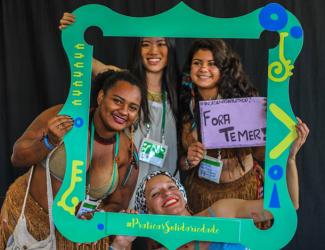
Young feminist activists play a critical role in women’s rights organizations and movements worldwide by bringing up new issues that feminists face today. Their strength, creativity and adaptability are vital to the sustainability of feminist organizing.
At the same time, they face specific impediments to their activism such as limited access to funding and support, lack of capacity-building opportunities, and a significant increase of attacks on young women human rights defenders. This creates a lack of visibility that makes more difficult their inclusion and effective participation within women’s rights movements.
A multigenerational approach
AWID’s young feminist activism program was created to make sure the voices of young women are heard and reflected in feminist discourse. We want to ensure that young feminists have better access to funding, capacity-building opportunities and international processes. In addition to supporting young feminists directly, we are also working with women’s rights activists of all ages on practical models and strategies for effective multigenerational organizing.
Our Actions
We want young feminist activists to play a role in decision-making affecting their rights by:
-
Fostering community and sharing information through the Young Feminist Wire. Recognizing the importance of online media for the work of young feminists, our team launched the Young Feminist Wire in May 2010 to share information, build capacity through online webinars and e-discussions, and encourage community building.
-
Researching and building knowledge on young feminist activism, to increase the visibility and impact of young feminist activism within and across women’s rights movements and other key actors such as donors.
-
Promoting more effective multigenerational organizing, exploring better ways to work together.
-
Supporting young feminists to engage in global development processes such as those within the United Nations
-
Collaboration across all of AWID’s priority areas, including the Forum, to ensure young feminists’ key contributions, perspectives, needs and activism are reflected in debates, policies and programs affecting them.
Related Content
Contributors of toolkit (WITM landing page)
Deseamos agradecer a las personas que hicieron aportes y fueron consultadas para la elaboración de este Manual:
- Angelika Arutyunova
- Cindy Clark
- Kamardip Singh
- Martin Redfern
- Pei Yao Chen
- Srilatha Batliwala
- Veronica Vidal
Sarah Maldoror
“Je n’adhère pas au concept de ‘tiers-monde’. Je fais des films pour que les gens puissent les comprendre indépendamment de leur race ou de leur couleur. Pour moi, il n’y a que des exploiteurs et des exploités, c’est tout. Faire un film, c’est prendre position.” - Sarah Maldoror
Sarah Maldoror, cinéaste française d’origine antillaise, fut une pionnière du cinéma panafricain. Elle plaça ses préoccupations politiques et son engagement de longue date dans les mouvements de décolonisation au coeur de son oeuvre.
Son film révolutionnaire Sambizanga (1972), avec son “image révolutionnaire”, retrace la lutte de libération anticoloniale des activistes angolais et retranscrit le point de vue d’une femme qui se trouve dans ce moment historique.
“Pour beaucoup de cinéastes africains, le cinéma est un outil de la révolution, une éducation politique pour transformer les consciences. Il s’inscrivait dans l’émergence d’un cinéma du Tiers-Monde cherchant à décoloniser la pensée pour favoriser des changements radicaux dans la société.” - Sarah Maldoror
Au cours de sa carrière, Sarah a fondé, aux côtés d’un certain nombre d’artistes africain·e·s et caribéen·ne·s, la première compagnie de théâtre noire en France (1956). Elle a réalisé une quarantaine de films, y compris d’importants documentaires qui mettent en valeur les vies et l’oeuvre d’artistes noir·e·s, notamment celles de son ami et poète Aimé Césaire qui lui écrivit ceci:
“À Sarah Maldoror qui, caméra au poing,
combat l’oppression, l’aliénation
et défie la connerie humaine”.
Sarah a également voulu permettre aux femmes africaines de s'approprier davantage le processus de réalisation des films. Dans une interview, elle faisait remarquer :
"La femme africaine doit être partout. Elle doit être à l'image, derrière la caméra, au montage, à toutes les étapes de la fabrication d'un film. C'est elle qui doit parler de ses problèmes…”
Sarah a laissé un héritage incroyablement puissant qui doit être transmis.
Née le 19 juillet 1929, Sarah est décédée le 13 avril 2020 des suites de complications liées au coronavirus.
Regardez Sambizanga et lisez la critique de film parue dans le New York Times en 1973 (seulement en anglais)
¿Qué idiomas estarán incluidos en el Foro?
Inglés, francés, español, y chino mandarín.
Snippet - CSW69 - Feminist Solidarity Space - FR
Espace de solidarité féministe
✉️ Sur inscription pour les grands groupes. Espace ouvert pour les petits groupes. Inscrivez-vous ici
📅 Mardi 11 mars 2025
🕒12.00h-14.00h et 16.00h-18.00h EST
🏢 Chef's Kitchen Loft with Terrace, 216 East 45th St 13th Floor New York
Organisé par : AWID
Snippet FEA Get Involved Story 4 (FR)
English article
French body
- Entered French content first (within the English site)
- Translated to English from French article (within the English site)
FRMag - United against violence (FR)
Ensemble contre la violence
par Karina Ocampo
C’est dans un recoin caché du Chiapas, au Mexique, que nous sommes arrivées, femmes et dissidentes sexuelles, pour organiser nos actions. (...)
< illustration : « La muerte sale por el Oriente » [la mort se lève à l’Est], par Sonia Madrigal
Safia Ahmed-Jan

Gloria Chicaiza
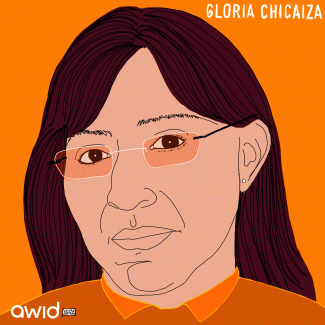
Gloria Chicaiza, an Ecuadorian social and environmental activist, was a fervent defender of land and water. She defied the status quo, fighting against a model of development based on extraction and worked tirelessly for ecological justice and the rights of communities affected by mining.
In diverse areas of Ecuador, Gloria was part of resistance actions in favour of protecting the ecosystem. With passion and dedication, Gloria supported the indigenous and environmental movement, its communities and organizations who oppose mining projects and protect their territories and collective life projects. She spoke out, in local and international foras, against the criminalization of dissent and resistance, the pressure and violence being enacted against community activists, in particular, women human rights defenders and in support of community led efforts for food sovereignty and sustainability.
She was the Mining Justice Coordinator at Acción Ecológica, member of the Latin American Network of Women Defenders of the Social and Environmental Rights and a Board member at the Observatory of Mining Conflicts of Latin America.
In October 2010, Gloria was accused by the mining company Curimining / Salazar Resources S.A. (with Headquarters in Vancouver, Canada) of sponsoring an act of terrorism, sabotage and illegal association to commit a crime. Acción Ecológica believed this to be “in retaliation for her work of denouncing the impacts of mining activities in the country.”
In 2014, Gloria supported the coordination of a delegation to the UN COP 20 Dialogue on Climate Change. The group consisted of 25 Indigenous women from Latin America.
Gloria passed away due to complications from a lung transplant on December 28, 2019. She is remembered for her resistance and tireless work.
"The fastest way to achieve sustainability is still resistance." - Gloria Chicaiza (2010 interview)
Tributes:
“Para GLORIA. GLORIA Agua. GLORIA Tierra. GLORIA Madre. GLORIA Revolución. GLORIA Hermana. GLORIA Cielo. GLORIAmiga. GLORIAstral. Thank you for weaving us together.” -Liliana Gutierrez
“Thank you Glorita, for sustaining hope, for keeping the fabric strong, for connecting the community, for the united hands, for solidarity, thank you Glorita for standing with us in the most difficult moments. Thank you for teaching us that throughout life, nobody gets tired.” (Chakana News)
“Gloria Chicaiza cherished and flourished in being one of many. And as humble as she was, she had an uncanny ability to lead and maintain a steady and thunderous beat, a life-affirming pulse that guided, mobilized, and inspired communities and networks in the protection of Mother Earth. She denounced all forms of violence against cuerpos-territorios. She endorsed el buen vivir.” - Gabriela Jiménez, Latin America Partnerships Coordinator, KAIROS
“Thank you Gloria Chicaiza from infinity we are sure that you will continue to support our struggle. You who continued to struggle with us despite your failing health. You will live on in the forests and the water that you defended with such courage. You will live on in our hearts.”- The community of Intag in Ecuador
¿Qué ocurre con las propuestas enviadas a través del Llamado actividades?
- La primera selección de actividades la realizará el personal de AWID.
- A quienes propusieron las actividades que pasen esa primera selección lxs invitaremos a participar de un proceso de votación. Las propuestas más votadas se incluirán en el programa del Foro. AWID podrá hacer algunos ajustes a la selección final para garantizar que nuestro programa guarde un equilibrio adecuado entre regiones, colectivos, temáticas y metodologías.
- El Comité de Contenidos y Metodología del Foro se pondrá en contacto con lxs organizadorxs de las actividades seleccionadas para apoyarlxs en el desarrollo de sus actividades.
Actualizaremos los resultados de este proceso en el sitio web a su debido tiempo.
Snippet - Resources to rally - FR
Ressources à mobiliser en vue de la CSW69
Snippet FEA Intro Acknowledgments (EN)
We would like to thank the Amar.ela collective of women feminists activists and creatives who made this series possible, and especially Natalia Mallo (the team’s octopus) for her support and accompaniment throughout this journey.
We also extend our deepest gratitude and admiration to all the collectives and people who participated in this project, and we thank them for sharing their time, wisdom, dreams and hopes with us. We thank you for making this world a more just, feminist and sustainable one.
We hope the rest of the world will be as inspired by their stories as we are.
Activism in the Middle East and North Africa
In our 2015 Online Tribute we honor five Women Human Rights Defenders murdered in the Middle East and North Africa region. These defenders worked for women and civil rights as lawyers and activists. Their death highlights the often dangerous and difficult working conditions in their respective countries. Please join AWID in honoring these women, their activism and legacy by sharing the memes below with your colleagues, networks and friends and by using the hashtags #WHRDTribute and 16Days.
Please click on each image below to see a larger version and download as a file


FRMag - Esmeralda takes over the Internet
Esmeralda takes over the Internet : How social media has helped Romani women to reclaim visibility
by Émilie Herbert-Pontonnier
Remember Esmeralda? The exotic "Gypsy" heroine born under the pen of the French literary giant Victor Hugo and popularized by Disney studios with their Hunchback of Notre Dame. (...)
< artwork: “Si las marronas lo permiten” by Nayare Soledad Otorongx Montes Gavilan
Rachel Bhagwan
Lorena Borjas
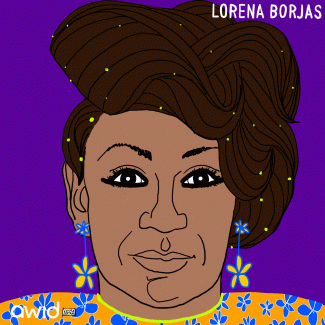
Lorena Borjas, una mujer trans latina y activista, vivía y trabajaba en el barrio de Jackson Heights de Queens, en la ciudad de Nueva York. En esas calles, cuidó de su comunidad durante años, defendiendo los derechos de las personas trans e inmigrantes, apoyando a lxs sobrevivientes del tráfico humano y del abuso, y haciendo campaña por los derechos de lxs trabajadorxs sexuales y de las personas que viven con VIH y SIDA.
Lorena era fuerte e incansable en su lucha por apoyar, defender y proteger a quienes son más marginalizadxs y discriminadxs por la transfobia, la misoginia y el racismo.
«Ella nos empujaba a brillar auténticamente, a convertirnos en un grito de subversión que dice “Aquí estoy, y merezco felicidad también”.» - Cecilia Gentili, activista trans amiga de Lorena
Luego de haber enfrentado ella misma numerosos traumas y dificultades como mujer trans inmigrante y víctima de tráfico humano, recabó conocimientos y memoria emocional de la fuente de sus propias experiencias para ayudar a construir y fortalecer la comunidad de la cual era parte, y que era parte de ella. Algunas de las formas en que llevó esto a cabo fue organizando y movilizando apoyo, que abarcaba desde proveer preservativos y conectar a las mujeres trans con distintos servicios sociales, hasta armar una clínica para el testeo de VIH en su propia casa.
«Era un alma tan bella que ayudaba a otrxs, aun cuando su propio camino era difícil y doloroso como inmigrante, como inmigrante trans. Creía que la comunidad trans necesitaba amor, aceptación, y compasión, y lo daba todo.» - Luchia Dragosh, supervisora de producción de QPTV de un documental sobre Lorena
En sus más de 25 años de activismo, también fundó con Chase Strangio (abogadx y activista por los derechos trans) el Lorena Borjas Community Fund. Este fondo ayuda a lxs diferentes integrantes de su comunidad (y en especial a las personas trans) que lidian con problemas de inmigración, para evitar el ciclo de arresto-cárcel-deportación.
Lorena falleció en marzo de 2020 por complicaciones derivadas del COVID-19.
Su enorme y hermoso legado será llevado adelante a través de las calles de Queens por la red y la comunidad que ella ayudó a crear.
« Continuaremos su trabajo desde donde ella lo dejó, un trabajo que es esencial para el bienestar de “mis pájaras”, como llamaba Lorena a las chicas trans de Queens que protegía bajo su ala.» - Cecilia Gentili
Tributos:
«Lorena nos trajo luz, cuando atravesábamos tiempos muy oscuros aquí en Nueva York. Nos trajo luz cuando tuvimos que enfrentar la epidemia del crack, cuando tuvimos que enfrentar la crisis del SIDA, cuando tuvimos que enfrentar los cambios en las políticas de inmigración.» - Cristina Herrera, fundadora y CEO de Translatina Network y amiga de Lorena
«Lorena ha hecho más que nadie que yo conozca para arrojar luz sobre la epidemia del tráfico en las comunidades transgénero y para ayudar a otras mujeres trans a escapar de la explotación.» - Lynly Egyes, representante de Borjas en nombre del Transgender Law Center
Mira un documental sobre Lorena Borjas (solo en inglés)
Lee un artículo publicado en The New Yorker sobre Lorena Borjas (solo en inglés)
Lee una nota de opinión de Cecilia Gentili publicada en The New York Times (solo en inglés)
¿Necesito visa para asistir al Foro de Taipéi?
Si tienes pasaporte de alguno de los siguientes países (el tiempo de estadía permitido varía según el país), NO necesitas visa para asistir al Foro de Taipéi:
Alemania, Andorra, Australia, Austria, Bélgica, Belice, Bulgaria, Brunei, Canadá, Chile, Ciudad del Vaticano, Croacia, Chipre, Dinamarca, Eslovaquia, Eslovenia, Estados Unidos de América, Estonia, España, Esuatini, Filipinas, Finlandia, Francia, Grecia, Guatemala, Haití, Honduras, Hungría, Irlanda, Islandia, Israel, Italia, Japón*, Letonia, Liechtenstein, Lituania, Luxemburgo, Malasia, Malta, Islas Marshall, Mónaco, Nauru, Nueva Zelanda, Nicaragua, Noruega, Países Bajos, Palaos, Paraguay, Polonia, Portugal, Reino Unido, República Checa, República de Corea, República Dominicana, Rumania, Rusia, San Cristóbal y Nieves, San Marino, Santa Lucía, San Vicente y las Granadinas, Singapur, Suecia, Suiza y Tuvalu.
Las personas con cualquier otro pasaporte NECESITARÁN VISA para ir a Taipéi.
Por favor ten en cuenta:
Es probable que, una vez que te hayas inscripto para asistir al Foro, te llegue un código relacionado con el evento que te permitirá tramitar tu visa en forma electrónica, cualquiera sea tu ciudadanía.
Brindaremos más información sobre este tema cuando se abra el proceso de inscripción.
Snippet - CSW69 - Transfeminist Alliances - EN
Transfeminist Alliances Against Fascism
✉️ By registration only. Register here
📅 Thursday, March 13, 2025
🕒 09.30-11.30am EST
🏢 Outright International Office, 17th Floor, 216 E 45th Street, New York
🎙️AWID speaker: Inna Michaeli, Co-Executive Director
Organizer: Outright International
Snippet - GII Intro (FR)
Investissement à impact de genre et émergence de fausses solutions :
une analyse pour les mouvements féministes
L'investissement à impact de genre est désormais considéré comme une solution contre les inégalités de genre. Et pourtant, comme le montre notre rapport, il fait partie du problème. Les institutions publiques et privées en font la promotion en tant que moyen pour parvenir à l'égalité de genre et pour accroître les ressources des femmes et des filles.
Mais en aucun cas, ces affirmations ne sont étayées par des preuves.
Au contraire, l’investissement à impact de genre constitue plutôt une nouvelle version de vies et de sociétés soumises à une même logique financière, qui continue de façonner les profondes inégalités de notre monde.
Avec ce rapport, l'AWID offre aux lecteurs·rices - féministes, défenseur·euse·s de la justice de genre et autres parties prenantes de l'investissement à impact de genre - une analyse critique et des preuves étayées pour comprendre l’investissement à impact de genre, ses récits et les implications économiques et politiques qu’il a pour les mouvements féministes.