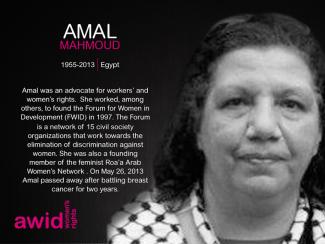
Ahmal Mahmoud
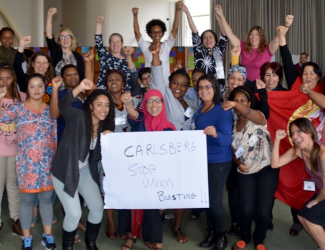
Women human rights defenders (WHRDs) worldwide defend their lands, livelihoods and communities from extractive industries and corporate power. They stand against powerful economic and political interests driving land theft, displacement of communities, loss of livelihoods, and environmental degradation.
Extractivism is an economic and political model of development that commodifies nature and prioritizes profit over human rights and the environment. Rooted in colonial history, it reinforces social and economic inequalities locally and globally. Often, Black, rural and Indigenous women are the most affected by extractivism, and are largely excluded from decision-making. Defying these patriarchal and neo-colonial forces, women rise in defense of rights, lands, people and nature.
WHRDs confronting extractive industries experience a range of risks, threats and violations, including criminalization, stigmatization, violence and intimidation. Their stories reveal a strong aspect of gendered and sexualized violence. Perpetrators include state and local authorities, corporations, police, military, paramilitary and private security forces, and at times their own communities.
AWID and the Women Human Rights Defenders International Coalition (WHRD-IC) are pleased to announce “Women Human Rights Defenders Confronting Extractivism and Corporate Power”; a cross-regional research project documenting the lived experiences of WHRDs from Asia, Africa and Latin America.
"Women Human Rights Defenders confronting extractive industries: an overview of critical risks and Human Rights obligations" is a policy report with a gender perspective. It analyses forms of violations and types of perpetrators, quotes relevant human rights obligations and includes policy recommendations to states, corporations, civil society and donors.
"Weaving resistance through action: Strategies of Women Human Rights Defenders confronting extractive industries" is a practical guide outlining creative and deliberate forms of action, successful tactics and inspiring stories of resistance.
The video “Defending people and planet: Women confronting extractive industries” puts courageous WHRDs from Africa, Asia, and Latin America in the spotlight. They share their struggles for land and life, and speak to the risks and challenges they face in their activism.
Challenging corporate power: Struggles for women’s rights, economic and gender justice is a research paper outlining the impacts of corporate power and offering insights into strategies of resistance.
AWID acknowledges with gratitude the invaluable input of every Woman Human Rights Defender who participated in this project. This project was made possible thanks to your willingness to generously and openly share your experiences and learnings. Your courage, creativity and resilience is an inspiration for us all. Thank you!
Samira fue una activista siria bajo el régimen de Bashar al-Asad.
Desde muy joven, se opuso a todas las formas de despotismo, especialmente en relación al régimen autoritario en el que vivía. En 2013, Samira fue secuestrada junto a otrxs tres destacadxs activistas. Se cree que se la llevaron del Centro para la Documentación de Violaciones de Duma, en el área rural de Damasco.
El principal sospechoso de su desaparición es el Ejército del Islam (el cual niega estar involucrado). No ha habido una investigación formal de la desaparición de Samira y desde entonces no se ha sabido nada de ella. Samira estaba comprometida con su país y se negaba a abandonar Siria hasta tanto no sintiera que su trabajo por el empoderamiento de las mujeres y en la documentación de los crímenes ya no fuera necesario.

|
تقديم تحليل محدّث، قوي، مبني على الأدلة ومسيّر نحو النشاط عن وقائع التمويل النسوي للتنظيمات النسوية ووضع البيئة التمويلية النسوية لأعضاء وعضوات AWID، الشركاء/ الشريكات في الحركة والممولين/ات. |
1 |
|
|
تحديد وإظهار الفرص للتحول لتمويل أفضل وأكبر للحركات النسوية، لكشف الحلول الزائفة ووقف التوجه الذي يجعل التمويل يتحرك ضد الأجندات التقاطعية أو أجندات العدالة الجندرية. |
2 |
|
|
تحديد الرؤى المقترحات والأجندات النسوية، لتمويل يحقق العدالة. |
3 |
|
AWID works towards the realization of gender justice and women’s human rights worldwide. We work to strengthen the voices and impact of women’s rights advocates, organizations and movements. Our main Priority Areas relate to themes that are closely linked to dominant global trends.
These themes reflect growing challenges that negatively impact women’s rights worldwide.
Tonya Haynes, CAISO
Angelique V. Nixon, CAISO

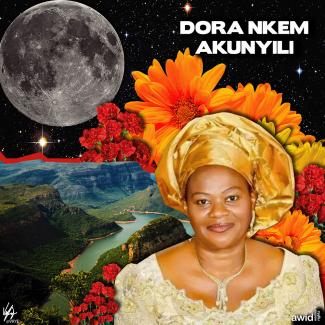
Née dans l'État de Benue, au Nigeria, Dora était une pharmacienne experte et érudite ainsi qu’une dirigeante communautaire de renommée mondiale.
Lorsqu'elle est devenue directrice générale de l'Agence nationale pour la gestion et le contrôle des aliments et drogues (NAFDAC) entre 2001 et 2008, son travail d’envergure révolutionnaire a initié un changement de paradigme au sein de la fonction publique nigériane. Au cours de son mandat, elle a mené des réformes dans l'application des politiques et des réglementations qui ont permis de réduire de manière radicale le nombre de faux médicaments qui ont affecté le secteur pharmaceutique nigérian.
Après avoir incarné la réalité d’une femme courageuse et compétente qui a défié les maux d’une société à dominante patriarcale et qui a conduit au changement, elle est devenue une icône de l’émancipation des femmes. Entre 2008 et 2010 elle a été nommée ministre de l'Information et de la Communication.
Elle est décédée des suites d'un cancer et laisse dans le deuil son mari, ses six enfants et ses trois petits-enfants.
Группы, организации и движения, работающие исключительно или главным образом в интересах женщин, девочек, гендерной справедливости, прав ЛГБТКИ+ людей во всех регионах и на всех уровнях, как недавно созданные, так и давно существующие.
Todos nuestros informes anuales estan disponibles en línea.
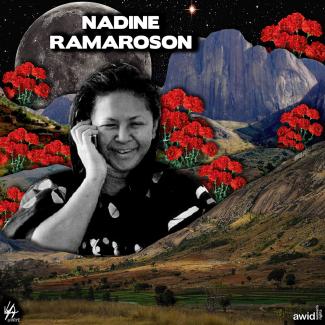
Nadine was a role model to many for her work supporting women and the most vulnerable in her community. She was committed to helping the poor and homeless in particular.
Though her death was reported as an accident, the Ramaroson family, led by her father, André Ramaroson led an investigation that pointed to evidence that she had been murdered. She is reported to have died in a fatal accident occurred between Soanierano - Ivongo and Ste Marie - a story that has been refuted by her family.
She received numerous death threats for her bold political positions. Her case remains in court in Antananarivo (the capital of Madagascar).
Sim! Reconhecemos e valorizamos diferentes motivos pelos quais as feministas nos seus respetivos contextos não dispõem de financiamento externo: desde não serem elegíveis para se candidatar a subsídios e/ou receber dinheiro do exterior, até dependerem de recursos gerados autonomamente como uma estratégia política por si só. Queremos saber mais sobre vocês, independentemente da vossa experiência com financiamento externo.
En esta selección de películas encontrarán las voces de realizadoras que no solo se contentan con plasmar las realidades feministas que palpitan en cada rincón de este vasto y diverso territorio sino también trabajos que desde su gestación misma están cuestionando el para qué, quién y cómo se hace cine o audiovisual. Realizadoras o colectivos que entienden al cine como una herramienta de lucha, como algo más que imágenes que se disfrutan en una pantalla, que ven al cine y al audiovisual como instrumentos para potenciar una discusión o abrir un debate; en fin, como un recurso para la pedagogía popular y feminista.
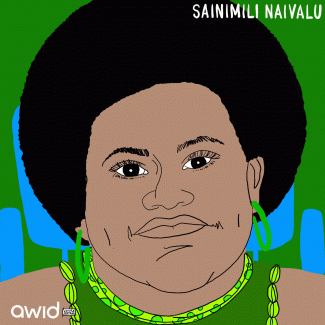
“I’ve witnessed discrimination on the streets, being teased on the streets and verbally abused on the streets. I have also made numerous friends and have met a lot of people. There may be dangers out there but I am a survivor and this is where I will be for now.”
- Sainimili Naivalu
She demanded policy makers and stakeholders provide disability friendly policies and services such as the construction of ramps in towns and cities to increase accessibility. Physical barriers were not the only ones she strived to change. From her own experience, she knew that more difficult changes need to take place in social and economic spheres. Many of the challenges disabled people face are rooted in attitudes that carry discrimination and stigma.
A survivor and a fighter, Sainimili contributed to co-creating feminist realities that foster inclusion and shift attitudes towards disabled people. As a member of the Spinal Injury Association of Fiji (SIA) and through Pacific Disability Forum’s Pacific Enable project she attended the International Labour Organisation “Start Your Business” training in Suva, enabling her to transform her ideas into her own business. She was an entrepreneur at the Suva Market Stall 7, offering manicure services, as well as running SIA’s women’s market stall selling handicrafts, sulus and artifacts. Sainimili’s plan was to expand her business and become a major employer of disabled people.
In addition to her activism, she was also a table tennis medalist and youth champion.
A vivacious personality, Sainimili was one of a kind. You would always know that Sainimili is in a room because her laughter and her stories would be the first thing that you would notice.
- Michelle Reddy
Sainmili passed away in 2019.
حالياً سيتواجد الاستطلاع على منصة KOBO باللغات العربية، الإنجليزية، الفرنسية، البرتغالية، الروسية والاسبانية. ستكون لديكم/ن الفرصة لاختيار اللغة التي تريدون تعبئة الاستطلاع بها في بداية الاستطلاع.
Second High-level Dialogue on Financing for Development