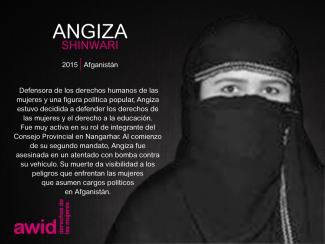
Angiza Shinwari
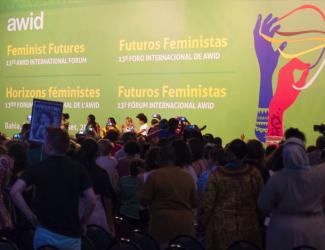
In September 2016, the 13th AWID international Forum brought together in Brazil over 1800 feminists and women’s rights advocates in a spirit of resistance and resilience.
This section highlights the gains, learnings and resources that came out of our rich conversations. We invite you to explore, share and comment!
One of the key takeaways from the 2016 Forum was the need to broaden and deepen our cross-movement work to address rising fascisms, fundamentalisms, corporate greed and climate change.
With this in mind, we have been working with multiple allies to grow these seeds of resistance:
And through our next strategic plan and Forum process, we are committed to keep developing ideas and deepen the learnings ignited at the 2016 Forum.
AWID Forums started in 1983, in Washington DC. Since then, the event has grown to become many things to many peoples: an iterative process of sharpening our analyses, vision and actions; a watershed moment that reinvigorates participants’ feminisms and energizes their organizing; and a political home for women human rights defenders to find sanctuary and solidarity.
Claro que sim! Encorajamo-lo a compartilhar a ligação do nosso inquérito com as suas redes. Quanto mais perspetivas diversas recolhermos, melhor será a nossa compreensão do cenário financeiro para a organização feminista.
L’AWID propose la Boîte à outils « Où est l’argent pour les droits des femmes? » (« Where Is The Money for Women's Rights? », WITM) pour soutenir les individus et les organisations qui souhaitent mener leur propre recherche sur les tendances de financement en adaptant la méthodologie de recherche de l’AWID à une région, une question ou une population spécifique.
La Boîte à outils WITM de l’AWID est le produit de dix ans de recherches. La rméthologie WITM de l’AWID proposent une démonstration politique et pratique des ressources et des étapes qu’exige une solide recherche-action.
L’équipe 'Ressources des mouvements féministes' offre également un soutien technique et politique, avant et pendant le processus de recherche. Parcourez la boîte à outils et contactez fundher@awid.org si vous souhaitez plus de renseignements.
Curado por Jess X. Snow
Con asistencia de Kamee Abrahamian y Zoraida Inglés
Editado por Kamee Abrahamian
A través de Asia y el Pacífico, y de toda su vasta diáspora, mujeres feroces y personas trans han estado luchando por un futuro en el que todxs puedan ser libres. A medida que la subida de los niveles del mar amenaza a las islas del Pacífico y las costas de Asia continental, la batalla por proteger la Tierra y los océanos se intensifica en todo el mundo. Nuestro planeta guarda una memoria geológica de todo lo que ha experimentado. El auge de la colonización, la industrialización y la destrucción ambiental está conectado con el crecimiento del Estado-Nación patriarcal binario. El poder que reside en la Tierra para reencarnar, sanar y florecer a pesar de la violencia debe, por lo tanto, conectarse con las mujeres, con la maternidad, con la indigeneidad, y con todas las fuerzas expansivas, sagradas y queer. No es una coincidencia que las realidades feministas unan la lucha por la protección de los derechos de las mujeres y de las personas trans y LGBTQ+ con la lucha por la protección de la Tierra. Desde las madres-hijas protectoras de Mauna Kea en el Reino de Hawái hasta las complejas relaciones madre-hijx de lxs refugiadxs vietnamitas, los despertares sexuales queer en la conservadora India, la recuperación del hogar en Mongolia Interior y la lucha por la liberación LGBTQ en Filipinas: esta colección de películas es una cosmología de las formas en las que las mujeres y las personas queer y trans contemporáneas de Asia-Pacífico defienden el camino hacia nuestra liberación colectiva, a través de océanos y fronteras.
Todas estas películas tienen un fuerte sentido de lugar: activistas indígenas protegen sus territorios sagrados, lxs jóvenes despejan las narrativas coloniales de su tierra natal para descubrir verdades ocultas, se exploran complejas relaciones de maternidad y cuidados, y lxs personajes recurren a sus propios cuerpos y a su sexualidad como santuario, cuando la familia y la ciudad que lxs rodea amenazan su seguridad.
por Jess X. Snow
«Una película inolvidable, con asombrosas tomas que invocan la resistencia ambiental feminista, y cuán profundamente arraigada está esa resistencia en la historia cultural y en la tierra...»
- Jessica Horn, activista feminista panafricana, escritora y co-creadora del sitio web the temple of her skin
En el documental experimental Afterearth, cuatro mujeres luchan por preservar el volcán, el océano, la tierra y el aire para las generaciones futuras. A través de música, poesía y sentidos testimonios que honran zonas próximas al Océano Pacífico: Hawái, Filipinas, China y América del Norte, Afterearth es una meditación poética sobre la relación intergeneracional y feminista de cuatro mujeres con las tierras y las plantas de las cuales provienen.
por Jalena Keane Lee
En Standing Above the Clouds, dos activistas nativas hawaianas (madre e hija) luchan juntas para proteger su montaña sagrada, Mauna Kea, y evitar que sea utilizada como sitio de la construcción de uno de los telescopios más grandes del mundo. Como protectoras de Mauna Kea, esta película muestra la relación interconectada entre Aloha ʻĀina (amor a la tierra) y el amor a lxs ancianxs y a las generaciones venideras.
por Quyên Nguyen-Le
En el cortometraje narrativo experimental Nước (agua/tierra natal) unx adolescente vietnamita-estadounidense genderqueer desafía las narrativas dominantes sobre la Guerra de Vietnam en Los Ángeles, California. A través de potentes secuencias oníricas y quiebres de la realidad, esta película sigue el camino de lx joven que intenta reconstruir y entender la experiencia de su madre como refugiada de la Guerra de Vietnam.
por Kimi Lee
En Kama’āina, una joven queer de dieciséis años debe pilotear su vida en las calles de Oahu hasta que, finalmente, guiada por una tía, encuentra refugio en el Pu’uhonua o Wai’anae, el campamento organizado de personas sin techo más grande de Hawái.
por Karishma Dev Dube
En Devi (diosa, en hindi) Tara, una joven lesbiana no declarada, arriesga tanto su familia como su tradición al aceptar su atracción por la criada de su infancia. Ambientada en Nueva Delhi, Devi es una historia de transición a la adultez, así como un comentario sobre las distinciones sociales y de clase que actualmente dividen a las mujeres en la India contemporánea.
por Yuan Yuan
En Heading South, Chasuna, una niña de 8 años criada por su madre en la meseta de Mongolia Interior, visita a su padre violento en la gran ciudad. En casa de su padre se encuentra con una nueva incorporación a la familia, y debe aceptar el hecho de que su verdadero hogar es inseparable de su madre y de su tierra.
por Johnny Symons & S. Leo Chiang
El largometraje Outrun sigue la trayectoria de la primera mujer transgénero del Congreso de Filipinas. Confrontando la opresión de una nación predominantemente católica, su viaje triunfal se convierte en un clamor por los derechos de las personas LGBTQ+ de todo el mundo.
Abarcando formas documentales, narrativas y experimentales, estas películas muestran que los cuidados comunitarios, el amor por unx mismx y la escucha transformadora profunda entre nuestros seres amados son un portal a las realidades feministas a las que hoy estamos dando existencia. Desde toda la zona de Asia-Pacífico y su diáspora, estas historias nos enseñan que, frente a la violencia, la ternura es la fuerza de resistencia más intensa.
Mira nuestra conversación con lxs cineastxs
Facebook: @AWIDWomensRights
Instagram: @awidwomensrights
Twitter ENG: @awid
Twitter ES: @awid_es
Twitter FR: @awid_fr
LinkedIn: Association for Women's Rights in Development (AWID)
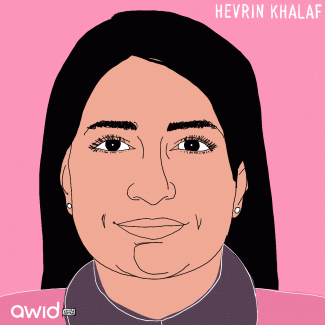
Hevrin Khalaf was a prominent Syrian Kurdish political leader in the autonomous region of Rojava where Kurdish women are risking their lives to resist the Turkish offensive and build a feminist system.
She was Secretary-General of the Future Syria Party (FSP), a group that aimed to build bridges, reconcile different ethnic groups and work towards a “democratic, pluralistic, and decentralized Syria.”
Hevrin was a symbol of this reconciliation effort. She also worked to promote equality between women and men and was a representative for visiting journalists, aid workers, and diplomats.
Hevrin was also a civil engineer from Derik, and was one of the founders of the Foundation for Science and Free Thought in 2012.
On 12 October 2019 she was tortured and murdered by the Turkish-backed militia, Ahrar al-Sharqiya during a military operation against Syrian Democratic Forces in Rojava.
“The killing of Khalaf is a turning point in Syria’s modern history. It once again demonstrated the old Kurdish proverb “no friends but the mountains.” I will always be a friend of Khalaf and her vision of a better world.” - Ahed Al Hendi
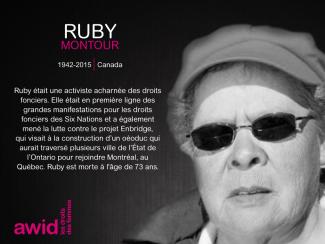
Tengo la convicción de que las mujeres empoderadas dotan de empoderamiento a otras mujeres, y es por ello que la he pasado tan bien como afiliada de AWID. Todo lo que sé y lo que entiendo de feminismo e interseccionalidad se ha ampliado gracias a los contactos que tuve como parte del Equipo de la Calle de la Comunidad AWID. Espero que más mujeres se sumen y compartan temas e ideas que ayuden a otras mujeres.- Loyiso Lindani, Sudáfrica.
by Karina Ocampo
In a hidden corner of Chiapas, Mexico, women and sexual dissidents have come to organize our actions. (...)
< artwork by Sonia Carolina Madrigal Loyola
Un réseau complexe et mouvant d’antidroits exerce une influence croissante dans les sphères internationales et les politiques locales. Souvent soutenu·e·s par des financements d’origine imprécise, ces acteur·rice·s renforcent leur impact en créant des alliances tactiques entre thématiques, régions et croyances.
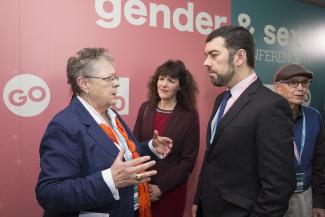
Alors que les discours des fascistes et fondamentalistes sont tout à fait nationalistes, leurs assises idéologiques, alliances politiques et réseaux de financement ne connaissent pas de frontières. Parfois soutenus par des flux de financement d’origine obscure, en lien avec de grosses entreprises ou des partis d’extrême droite, ces groupes concluent des alliances stratégiques, voire avec des sous-groupes de mouvements féministes et pour les droits des femmes, dans certains cas, tout en s’éloignant d’éléments ouvertement extrêmes pour acquérir davantage de légitimité. Ces acteur·rice·s diffusent et reproduisent également partout dans le monde leur modèle d’organisation antidroits : leurs manières de faire campagne, de faire pression ou de mener des actions stratégiques en justice.
Diana Isabel Hernández Juárez fue una maestra guatemalteca, defensora de los derechos humanos y activista comunitaria y del medioambiente. Fue la coordinadora del programa ambiental de la parroquia de Nuestra Señora de Guadalupe, en la costa sur del país.
Diana dedicó su vida a co-crear conciencia ambiental, y trabajó de modo particularmente estrecho con comunidades locales para abordar problemas ambientales y proteger los recursos naturales. Inició proyectos tales como viveros forestales, granjas municipales, huertas familiares y campañas de limpieza. Participó activamente en programas de reforestación, tratando de recuperar especies nativas y paliar la falta de agua, en más de 32 comunidades rurales.
El 7 de septiembre de 2019, Diana recibió disparos y fue asesinada por dos hombres armados desconocidos mientras se encontraba participando de una procesión en su comunidad. Diana tenía solamente 35 años en el momento de su muerte.
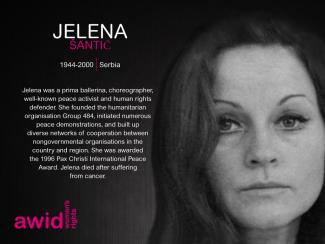
"We believe that this is the time for us to continue to organize from a place of solidarity, hope and radical imaginations."
- Beijing+30 & CSW: Feminist meaning-making at a time of polycrisis
por Prinka Saraswati
El ciclo menstrual habitualmente abarca entre 27 y 30 días. En ese lapso, el período en sí dura de 5 a 7 días. La fatiga, los cambios de humor y los espasmos son el resultado de la inflamación durante la menstruación.
< arte: «Movimiento feminista», Karina Tungari
Lost For Words |
 |
 |
| Chinelo Onwualu | Ghiwa Sayegh |
When we are desperate for change, as we are both in illness and insurrection, our language drains of complexity, becomes honed to its barest essentials... As illness and revolution persist, though, the language made in them and about them deepens, lets in more nuance, absorbed in the acutely human experience of encountering one’s limits at the site of the world’s end.
Johanna Hedva
When we began scheming for such an issue with Nana Darkoa, ahead of AWID’s Crear | Résister | Transform: a festival for feminist movements!, we departed from a question that is more of an observation of the state of the world – a desire to shift ground: why do our sexualities and pleasures continue to be tamed and criminalized even as we are told, over and over again, that they bring neither value nor progress? We came to the conclusion that when they are embodied, something about our sexualities works against a world order that continues to manifest itself in border controls, vaccine apartheids, settler colonialism, ethnic cleansing, and rampant capitalism. Could we speak, then, of the disruptive potential of our sexualities? Could we still do that when, in order to be resourced, our movements are co-opted and institutionalized.
When our embodied labor becomes profit in the hands of the systems we seek to dismantle, it is no wonder that our sexualities and pleasures are once again relegated to the sidelines – especially when they are not profitable enough. In many instances during the production of this issue, we asked ourselves what would happen if we refused to accommodate the essential services of capitalism. But can we dare ask that question when we are exhausted by the world? Perhaps our sexualities are so easily dismissed because they are not seen as forms of care. Perhaps what we need is to reimagine pleasure as a form of radical care – one that is also anti-capitalist and anti-institutional.
As we enter our second full year of a global pandemic, our approach to transnational embodiments has had to focus on a single political realization: that taking care is a form of embodiment. And because right now so much of our work is being done without consideration for the borders between and within ourselves, we are all Transnationally Embodied – and we are all failing. We are failing to take care of ourselves and more critically, to take care of each other.
This failure is not of our own making.
Many of our parents thought of labor as transactional, something to be given in exchange for compensation and a guarantee of care. And while that exchange was not always honored, our parents did not expect that their work would provide them fulfillment. They had their leisure, their hobbies, and their communities for that. Today, we their children, who have been conditioned to think of our labor as intertwined with our passion, have no such expectations. We think of work and leisure as one and the same. For too many of us, work has come to embody our whole selves.
However, heteropatriarchal capitalism doesn’t value us, let alone our labor or our sexualities. This is a system that will only demand more and more until you die. And when you die, it will replace you with somebody else. Expectations to be online round the clock mean we simply can’t get away from work, even when we want to. This commercialization of labor, divorcing it from the person, has infiltrated every aspect of our lives and is being perpetuated even in the most feminist, the most radical and revolutionary circles.
Capitalist expectations have always been particularly pernicious to bodies who don’t fit its ideal. And those seeking to consolidate their powers have used the pandemic as an opportunity to target women, sexual minorities, and any others that they see as less than.
This special issue exists because of, and certainly in spite of this.
Almost every contributor and staff member was pushing themselves past their capacity. Every single piece was produced from a place of passion, but also incredible burnout. In a very real way, this issue is an embodiment of transnational labor – and in the digital world we live in, all labor has become transnational labor. As we have to contend with new borders that do not break an old order but reify it, we experienced firsthand, alongside our contributors, how capitalism drains our limits – how it becomes difficult to construct cohesive arguments, especially when these come with a deadline. We collectively became lost for words – because we are lost for worlds.
Feeling lost and alone in the world of heteropatriarchal capitalism is exactly why we need to re-evaluate and rethink our systems of care. In many ways, we turned this issue into a mission of finding pleasure in care. Because it has become more difficult to construct cohesive arguments, visual and creative mediums have come to the forefront. Many who used to write have turned to these mediums as ways to produce knowledge and cut through the mental fog that’s enveloped us all. We brought into the issue other voices, in addition to many whom you heard at the festival, as a way of opening up new conversations, and extending our horizons.
As we are robbed of our words, it is our political duty to continue to find ways to maintain and care for ourselves and each other. So much of our current realities are trying to erase and displace us, while still exploiting our labor. Our embodiment, therefore, becomes a form of resistance; it is the beginning of us finding our way out and into ourselves.
« Je veux dire à tou·te·s les Tunisien·ne·s : Nous devons nous rassembler pour dire “non” à la censure et aux procès d’opinion. » - Lina Ben Mhenni (entretien de 2013)
« Un cyberactiviste doit aller sur le terrain, sentir ce que vivent les autres. On dit que la Révolution tunisienne est celle du Net, mais si elle n’était que ça, elle n’aurait jamais abouti ! » » Lina Ben Mhenni (article dans Ouest-France)
Elle a co-organisé en 2010 une manifestation en réaction à la suppression des médias et la censure sur Internet imposées par le gouvernement. Lina était très connue pour son blog « A Tunisian Girl » et son travail pendant la révolution tunisienne en 2011 était reconnu. Elle s’est servie de son blog pour transmettre des informations sur la révolte, partager des images documentant les manifestations, et a été parmi les rares voix qui s’élevèrent pour dénoncer les assassinats et la répression des manifestant·e·s à Sidi Bouzid. Lina était une des rares blogueuses à utiliser son vrai nom sur Internet, et non un pseudonyme pour protéger son identité.
« Notre liberté d’expression est vraiment en danger. Je crains que nous ne soyons en train de perdre les fruits magnifiques de notre révolution : la disparition de la peur et la liberté d’expression. Nous devons continuer de nous battre pour protéger et préserver ce droit. » - Lina Ben Mhenni (entretien de 2013)
Lina n’avait que 36 ans lorsqu’elle est décédée, le 27 janvier 2020, de complications d’une maladie auto-immune.
« La liberté, une meilleure éducation et la santé - c’est tout ce que nous voulions. Lorsque nous échouions, elle nous incitait à continuer. » Hala, l’institutrice de Lina.