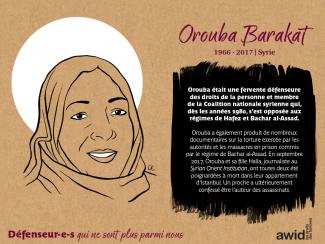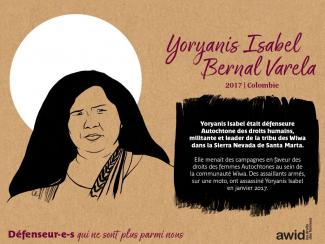
Yoryanis Isabel Bernal Varela
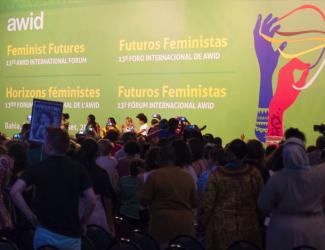
In September 2016, the 13th AWID international Forum brought together in Brazil over 1800 feminists and women’s rights advocates in a spirit of resistance and resilience.
This section highlights the gains, learnings and resources that came out of our rich conversations. We invite you to explore, share and comment!
One of the key takeaways from the 2016 Forum was the need to broaden and deepen our cross-movement work to address rising fascisms, fundamentalisms, corporate greed and climate change.
With this in mind, we have been working with multiple allies to grow these seeds of resistance:
And through our next strategic plan and Forum process, we are committed to keep developing ideas and deepen the learnings ignited at the 2016 Forum.
AWID Forums started in 1983, in Washington DC. Since then, the event has grown to become many things to many peoples: an iterative process of sharpening our analyses, vision and actions; a watershed moment that reinvigorates participants’ feminisms and energizes their organizing; and a political home for women human rights defenders to find sanctuary and solidarity.
Oui ! Veuillez lire notre Appel à activités et vous inscrire ici. La date limite est fixée au 1er février 2024.
Premier Dialogue de haut niveau sur le financement du développement, 29-30 octobre 2003.
Les dialogues de haut niveau de l’Assemble générale des Nations Unies sur le financement du développement, tenus tous les deux ans, sont l’un des mécanismes de suivi de la Conférence de Monterrey. À la suite de ce premier dialogue, huit tables rondes ont été organisées autour de différentes questions comprenant les subventions agricoles, le commerce, l’allègement de la dette et le financement des OMD. Toutes les discussions se concentraient sur les manières de faire face aux obstacles structurels qui pesaient sur ces questions et défavorisaient les nations « en développement ».
D'autres mécanismes de suivi de la Conférence de Monterrey :
La montée en puissance des antidroits a préparé son terrain. Nous devons comprendre la montée de l’ultranationalisme, du pouvoir incontrôlé des entreprises, de la répression croissante et de l’amenuisement de l’espace civique pour contextualiser les menaces actuelles contre nos droits.
This new report shines a light on the resourcing realities of feminist and women’s rights organizations amid unprecedented political and financial upheaval. Drawing on over a decade of analysis since AWID last Where is the Money? report (Watering the Leaves, Starving the Roots), it takes stock of the gains, gaps, and growing threats in the funding landscape.
The report celebrates the power of movement-led initiatives to shape resourcing on their own terms, while sounding the alarm on massive aid cuts, shrinking philanthropy, and escalating backlash.
It calls on funders to invest abundantly in feminist organizing as essential infrastructure for justice and liberation. It also invites movements to reimagine bold, self-determined models of resourcing rooted in care, solidarity and collective power.
If your group or organization receives funding, you might want to discuss with your funder already now if they are able to support your travel and participation to the Forum. Many institutions plan their budgets for next year early in 2023, so better not delay this conversation for next year.
The Fifth High- Level Dialogue on Financing for Development, 7 – 8 December 2011, marked the beginning of the Post 2015 development agenda discussions, and the link to financing for development. The conference gave a special focus to increasing aid to finance the MDG’s. In his closing remarks, the Secretary General called on members to begin to consider the post-2015 development framework.
Collection évolutive de ressources en soutien aux mouvements féministes, aux décideur·euse·s et aux allié·e·s pour contrer les fascismes, les fondamentalismes et résister aux tendances antidroits.

The climate summit by movements, for movements.
📅 November 12 - November 16, 2025
📍 Universidade Federal do Pará, Belém
Estamos en comunicación con reuniones regionales, temáticas y de donantes planificadas para 2023-2024, para garantizar el flujo de conversaciones y conexiones. Si estás organizando un evento y deseas establecer una conexión con el Foro de AWID, ¡por favor contáctanos!
The first report from the Observatory on the Universality of Rights acts as a compendium of information on anti-rights trends in international spaces. Find out about key anti-rights religious actors, discourses, and tactics within the UN.