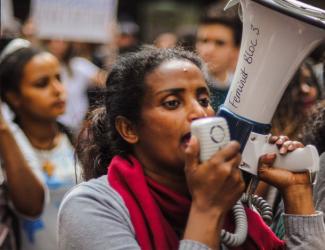
Anit-Racism Movement (ARM) / Flickr (CC BY-NC-ND 2.0)
Priority Areas
Supporting feminist, women’s rights and gender justice movements to thrive, to be a driving force in challenging systems of oppression, and to co-create feminist realities.
Around the world, feminist, women’s rights, and allied movements are confronting power and reimagining a politics of liberation. The contributions that fuel this work come in many forms, from financial and political resources to daily acts of resistance and survival.
AWID’s Resourcing Feminist Movements (RFM) Initiative shines a light on the current funding ecosystem, which range from self-generated models of resourcing to more formal funding streams.
Through our research and analysis, we examine how funding practices can better serve our movements. We critically explore the contradictions in “funding” social transformation, especially in the face of increasing political repression, anti-rights agendas, and rising corporate power. Above all, we build collective strategies that support thriving, robust, and resilient movements.
Our Actions
Recognizing the richness of our movements and responding to the current moment, we:
Create and amplify alternatives: We amplify funding practices that center activists’ own priorities and engage a diverse range of funders and activists in crafting new, dynamic models for resourcing feminist movements, particularly in the context of closing civil society space.
Build knowledge: We explore, exchange, and strengthen knowledge about how movements are attracting, organizing, and using the resources they need to accomplish meaningful change.
Advocate: We work in partnerships, such as the Count Me In! Consortium, to influence funding agendas and open space for feminist movements to be in direct dialogue to shift power and money.
"She was not a person. She was a power."
- a fellow activist remembering Navleen Kumar
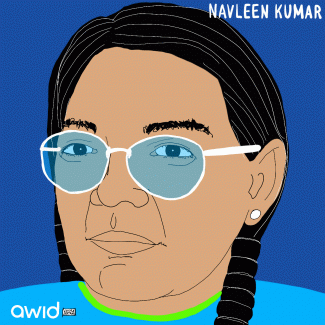
Navleen Kumar was a fervent land rights and social justice activist in India.
With commitment and integrity, she worked for more than a decade to protect and restore the lands of Indigenous people (adivasi) in Thane district, an area taken away by property and land developers using such means as coercion and intimidation. She fought this injustice and crime through legal interventions at different courts, realizing that manipulation of land records was a recurrent feature in most cases of land acquisition. In one of the cases, that of the Wartha (a tribal family), Navleen found out that the family had been cheated with the complicity of government officials.
Through her work, she helped restore the land back to the Wartha family and continued to pursue other cases of adivasi land transfers.
“Her paper on the impact of land alienation on adivasi women and children traces the history and complexities of tribal alienation from the 1970s, when middle class families began to move to the extended suburbs of Mumbai as the real estate value in the city spiralled.
Housing complexes mushroomed in these suburbs, and the illiterate tribals paid the price for this. Prime land near the railway lines fetched a high price and builders swooped down on this belt like vultures, to grab land from tribals and other local residents by illegal means.” -Jaya Menon, Justice and Peace Commission
During the course of her activism, Navleen received numerous threats and survived several attempts on her life. Despite these, she continued working on what was not only important to her but contributed to changing the lives and realities of many she supported in the struggle for social justice.
Navleen was stabbed to death on 19 June 2002 in her apartment building. Two local gangsters were arrested for her murder.
متى يمكنني التسجيل في المنتدى؟ كم هي تكلفة التسجيل؟ ماذا يشمل التسجيل؟
سيبدأ التسجيل أوائل العام 2024. وسنعلن عن تاريخ التسجيل المحدد ورسوم التسجيل قريبًا. سيتضمن التسجيل المشاركة في المنتدى، بالإضافة إلى الغداء والوجبات الخفيفة (يتم تقديم وجبة الإفطار في الفنادق)، وعشاء واحد في الموقع.
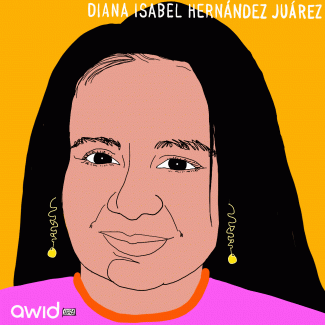
Diana Isabel Hernández Juárez was a Guatemalan teacher, human rights defender and environmental and community activist. She was the coordinator of the environmental program at Our Lady of Guadalupe Parish on the South coast of the country.
Diana dedicated her life to co-creating environmental awareness, working especially closely with local communities to address environmental issues and protect natural resources. She initiated projects such as forest nurseries, municipal farms, family gardens and clean-up campaigns. She was active in reforestation programmes, trying to recover native species and address water shortages, in more than 32 rural communities.
On 7 September 2019, Diana was shot and killed by two unknown gunmen while she was participating in a procession in her hometown. Diana was only 35 years old at the time of her death.
We are excited to share our new Strategic Plan (2023-2027) with the world. AWID will make an announcement to inform our community and members very soon.
The Association for Women's Rights in Development (AWID) is a global, feminist, membership, movement-support organization.
For 40 years, AWID has been a part of an incredible ecosystem of feminist movements working to achieve gender justice and women’s human rights worldwide.
Our vision
GGAADD | Flickr (CC BY-SA 2.0) - modified
AWID envisions a world where feminist realities flourish, where resources and power are shared in ways that enable everyone, and future generations, to thrive and realize their full potential with dignity, love and respect, and where Earth nurtures life in all its diversity.
Our mission
Our mission is to support feminist, women’s rights and gender justice movements to thrive, to be a driving force in challenging systems of oppression, and to co-create feminist realities.
Our tactics
We advance our work through these tactics:
Influencing, advocacy and campaigning
We collaboratively leverage our access, power, resources and relationships to strategically influence policy and practice. We aim to advance feminist agendas through our work with policy makers, funders and activists in regional and global spaces. We also work to influence feminist and women’s rights movements to centre historically oppressed movements as part of efforts to strengthen our collective power and influence.
Convening and connecting
We use our convening power to facilitate dialogue and strategize on key issues. We connect our members and allies with one another, sharing and exchanging resources, ideas and action across relevant issues. We organize and facilitate spaces to strengthen and engage across movements, to imagine and envisage new futures, to develop effective influencing tactics and to co-create powerful agendas and processes.
Solidarity and bridge-building
We work to mobilize our members and the movements we support to strengthen collective action in solidarity with feminist causes and defenders at risk. We build partnerships, engage in active listening and ongoing, long-term, solidarity. We work with defenders to build a body of knowledge and support networks of solidarity on protection and wellbeing.
Arts and creative expression
We recognize the unique and strategic value of cultural and creative strategies in the struggle against oppression and injustice. We work with artists who centre feminist voices and the narratives of historically oppressed communities. In this emerging tactic, we see art and creative expression helping us envision a world where feminist realities continue to flourish and be celebrated.
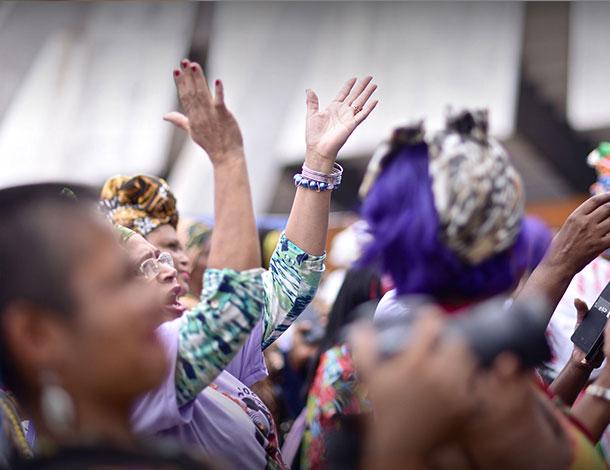
Marcha da Mulheres negras - 2016
Our initiatives
Our initiatives work at the intersections of the sites of change we work to address, the movements we prioritize, and the tactics we use:
We monitor, document and make visible how anti-rights actors are operating and colluding in multilateral spaces and support feminist, women’s rights and gender justice movements and allies to counter their influence and impact.
Working on extractivism, tax justice and corporate accountability, we build knowledge on corporate power and influence; advocate for corporate accountability and equitable distribution of wealth; and amplify feminist proposals for just economies.
We develop accessible, action-oriented analysis on the state of resourcing for feminist movements. We aim to influence funders’ policies and practices, deepen and sustain funding for feminist social change, and support movements’ needs and strategies.
In addition to the impact we aim to have in the world, AWID is expressly committed to strengthening our own organizational learning and resilience in order to further strengthen global feminist movements.
Our donors
Thank you!
Without the generous funding and support from our donors, our work would not be possible
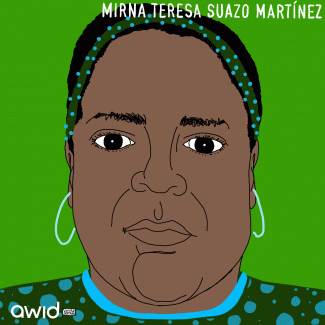
Mirna Teresa Suazo Martínez was part of the Garifuna (Afro-descendent and Indigenous) Masca community, living on the North Caribbean coast of Honduras. She was a community leader and a fervent defender of the Indigenous territory, a land that was violated when the National Agrarian Institute of Honduras gave territorial licenses to people outside of the community.
This deplorable deed resulted in repeated harassment, abuse and violence against the Masca, where economic interests of different groups met those of Honduran armed forces and authorities. According to the Black Fraternal Organization of Honduras (OFRANEH), the strategy of these groups is to evict and exterminate the Indigenous population.
“Masca, the Garifuna community located next to the Cuyamel Valley, is part of the area of influence of one of the supposed model cities, a situation that has triggered territorial pressures along the Garifuna coast.” - OFRANEH, 8 September 2019
Mirna Teresa, president of the Board of Trustees of the Masca Community in Omoa, was also firmly rejecting the construction of two hydroelectric plants on the river that carries the same name as her community, Masca.
“The Garífuna community attributes the worsening of the situation in their region to their opposition to tourist exploitation, the monoculture of African palm and drug trafficking, at the same time that it seeks to build an alternative life through the cultivation of coconut and other products for self-consumption.” - Voces Feministas, 10 September 2019
Mirna Teresa was murdered on 8 September 2019 in her Restaurant “Champa los Gemelos”.
She was one of six Garifuna women defenders murdered between September and October 2019 alone. According to OFRANEH, there was no investigation by the authorities into these crimes.
“In the case of the Garífuna communities, a large part of the homicides are related to land tenure and land management. However, squabbles between organized crime have resulted in murders, such as the recent ones in Santa Rosa de Aguán.” - OFRANEH, 8 September 2019
هل سيكون هناك دعم لترجمة لغة الإشارة بخلاف لغة الإشارة الدولية؟
إذا تم قبول مقترحك فسيتم الاتصال بك من قبل فريق جمعية حقوق المرأة في التنمية لتقييم احتياجات الترجمة الفورية وإمكانية الوصول والاستجابة لها.
Activism in the Middle East and North Africa
In our 2015 Online Tribute we honor five Women Human Rights Defenders murdered in the Middle East and North Africa region. These defenders worked for women and civil rights as lawyers and activists. Their death highlights the often dangerous and difficult working conditions in their respective countries. Please join AWID in honoring these women, their activism and legacy by sharing the memes below with your colleagues, networks and friends and by using the hashtags #WHRDTribute and 16Days.
Please click on each image below to see a larger version and download as a file
باختصار، نعم! تعمل جمعية حقوق المرأة في التنمية حاليًا مع لجنة إمكانية الوصول لضمان إمكانية الوصول إلى المنتدى قدر الإمكان. نحن نجري أيضًا تدقيقًا لإمكانية الوصول إلى مكان انعقاد المنتدى والفنادق المحيطة ووسائل النقل. ستكون المعلومات التفصيلية حول إمكانية الوصول في منتدى جمعية حقوق المرأة في التنمية متاحة في هذا القسم قبل فتح التسجيل. وفي الوقت نفسه، لأية أسئلة يرجى الاتصال بنا.
6. Conduct desk research
Desk research can be done throughout your research. It can assist you with framing, help you to choose survey questions and provide insights to your results.
Conducting desk research throughout your research process can assist you with framing, help you to choose survey questions and provide contextual clarity or interesting insights to your survey results, such as comparing similarities and differences between your survey results and information produced by civil society and donors.
Perhaps you notice trends in your survey data and want to understand them.
For example, your survey data may reveal that organization budgets are shrinking, but it cannot tell you why this is happening. Reviewing publications can give you context on potential reasons behind such trends.
Desk research also ensures you are building your research on the existing knowledge regarding your topic, confirming the validity and relevance of your findings.
They may be complimentary or contradictory to existing knowledge, but they must speak to existing data on the topic.
To ensure comprehensive research of the entire funding landscape related to your topic, look at a diverse set of funding sectors.
You can consider:
Women’s Funds
Private and Public Foundations
International Non-Governmental Organizations (INGOs)
Bilateral and Multilateral Agencies
Private Sector Actors
Individual Philanthropists
Crowdfunders
Include any other relevant sectors to this research.
For example, you may decide that it is also important to research local non-governmental organizations (NGOs).
Potential sources for desk research (non-exhaustive)
1. Donors’ websites and annual reports
These are direct sources of information about what funders are actually doing and generally contain information on policies and budgets. Researching this before interviewing donors can result in more focused questions and a stronger interview.
We would also like to thank the following people for their valuable contribution:
Nebila Abdulmelik
Radhika Balakrishnan
Selamawit Tesfaye
Hakima Abbas
Patita Tingoi
Ana Abelenda
Snippet - WITM to claim - EN
To claim your power as an expert on the state of resourcing for feminist movements
Twitter Test
@shalinikonanur sharing a comment by her colleague debbie @salco "we can talk about shattering the glass ceiling, but we have to talk about who are sweeping those broken glasses?" challenging the #G7 to truly see who's vulnerable domestically & globally #W7Canada@kramdas@AWIDpic.twitter.com/1rs0SpLYHp