L´AWID est une organisation féministe mondiale qui consacre ses efforts à la justice de genre, au développement durable et aux droits humains des femmes
S'opposer à l’extractivisme et au pouvoir des entreprises
Dans le monde entier, les femmes défenseuses des droits humains défendent leurs terres, leurs moyens de subsistance et leurs communautés contre le pouvoir des entreprises et des industries extractives. Elles se mobilisent et défient de puissants intérêts économiques et politiques qui motivent la spoliation de terres, le déplacement de communautés, la perte des moyens de subsistance et la dégradation de l'environnement.
Pourquoi résister à des industries extractives?
L’extractivisme est un modèle économique et politique de développement qui œuvre à la marchandisation de la nature et privilégie le profit au détriment des droits humains et de l'environnement. Enraciné dans l'histoire coloniale, il creuse les inégalités sociales et économiques au niveau local et mondial. Le plus souvent, les femmes rurales, noires ou autochtones sont les plus touchées par l’extractivisme et sont largement exclues des espaces de prise de décision en la matière. Les femmes se mobilisent pour défier ces forces patriarcales et néocoloniales et défendre les droits, les terres, les personnes et la nature.
Les principaux risques et les violences basées sur le genre
Les femmes qui s’opposent aux industries extractives vivent une série de risques, de menaces et de violations de leurs droits comme la criminalisation, la stigmatisation, la violence et l'intimidation. Leurs histoires révèlent des aspects évidents de violences sexuelles et basées sur le genre. Parmi les auteurs de ces abus se trouvent les autorités locales et fédérales, les entreprises, la police, les militaires, les forces de sécurité paramilitaires et privées, et parfois mêmes leurs propres communautés.
Agir ensemble
L'AWID et la Coalition internationale des femmes défenseures des droits humains (WHRDIC) ont le plaisir d'annoncer la sortie de leur publication « Les défenseuses des droits humains résistent à l’extractivisme et aux pouvoir des entreprises », un rapport basé sur un projet de recherche transrégional qui relate les expériences vécues par des défenseuses en provenance d'Asie, d'Afrique et d'Amérique latine.
Nous encourageons les activistes, les membres de mouvements sociaux, la société civile, les donateurs et les décideurs à lire et à faire usage des documents suivants pour leur travail de plaidoyer, comme outil pédagogique et comme source d’inspiration :
Dites-nous comment vous utilisez la boîte à outils sur les défenseur-e-s des droits humains qui résistent à l'extractivisme et aux pouvoir des entreprises.
◾️ Comment ces ressources peuvent-elles soutenir votre activisme et votre plaidoyer ?
◾️ De quelles informations ou connaissances supplémentaires avez-vous besoin pour utiliser au mieux ces ressources ?
C’est avec gratitude que l’AWID reconnaît les contributions précieuses de chaque défenseur-e des droits humains qui a participé à ce projet. Cette recherche a été rendue possible grâce à votre volonté à partager vos expériences. Votre courage, créativité et résilience est une source d’inspiration pour nous toutes et tous. Merci !
Contenu lié
كيف ستعرضون وتعالجون المعطيات التي ستجمعونها في الاستطلاع؟
سيتم جمع المعطيات لأهداف إحصائية لتسليط الضوء على وضع التمويل للحركات النسوية العالمية وسيتم عرضها فقط بشكل إجمالي. لن تنشر AWID المعلومات عن اي منظمة محددة ولن تعرض أي من المعلومات التي ستمكّن من التعرّف على منظمة عن طريق موقعها أو صفاتها دون موافقة المنظمة.
"Pero, ¿ fue el maestro alguna vez
seducido por el poder?
¿Alguna vez se rompió
un sistema con aceptación ?
¿Cuándo el JEFE te entregará el poder con amor?
¿En Jo'Burg, en Cancún o en la ONU? - Molara Ogundipe
En una entrevista, realizada en la Feria Internacional del Libro de Ghana de 2010, Molara Ogundipe se presentó con estas palabras "...Soy una nigeriana. He vivido, posiblemente, en todo el mundo, excepto en la Unión Soviética y China".
A través de los diferentes continentes y países, la profesora Ogundipe enseñó literatura comparada, escritura, género y filología inglesa, y utilizó la literatura como vehículo para la transformación social y el replanteamiento de las relaciones de género.
Molara Ogundipe, como pensadora, escritora, editora, crítica social, poeta y activista feminista, logró combinar el trabajo teórico con la creatividad y la acción práctica. Se la considera una de las principales voces críticas de los feminismos africanos, los estudios de género y la teoría literaria.
Molara acuñó el concepto de "estiwanismo" a partir de las siglas STIWA (Social Transformations in Africa Including Women) [Transformaciones Sociales en África Incluyendo a las Mujeres], con el fin de reconocer la necesidad de “alejar la definición del feminismo y los feminismos en relación con Euro-América u otro lugar, y declamar lealtades o deslealtades". Con su obra fundamental, "Recreándonos Nosotras Mismas", de 1994, Molara Ogundipe (publicada bajo el nombre de Molara Ogundipe-Leslie) dejó tras de sí un inmenso cuerpo de conocimientos que descolonizó el discurso feminista y "re-centró a las mujeres africanas en sus completas y complejas narrativas... guiadas por una exploración de la liberación económica, política y social de las mujeres africanas y la restauración de la agencia femenina en las diferentes culturas de África".
Comentando los retos a los que se enfrentó como joven académica, dijo:
"Cuando empecé a hablar y escribir sobre el feminismo a finales de los años sesenta y en los setenta, se me veía como una chica buena y admirable que se había extraviado, una mujer cuya cabeza se había arruinado con un exceso de aprendizaje".
Molara Ogundipe se destacó por su liderazgo a la hora de combinar el activismo con el mundo académico; en 1977 fue una de las fundadoras de la Asociación de Mujeres en la Investigación y el Desarrollo, AAWORD (por sus siglas en inglés),. En 1982 fundó Mujeres en Nigeria, WIN (por sus siglas en inglés), con el fin de abogar por un acceso pleno a los "derechos económicos, sociales y políticos" para las mujeres nigerianas. Posteriormente, estableció y dirigió la Fundación Internacional para la Educación y el Monitoreo y pasó muchos años en el consejo editorial del periódico The Guardian.
Luego de haber crecido con el pueblo yoruba, sus tradiciones, cultura e idioma, dijo una vez:
"Creo que la celebración de la vida, de las personas que mueren después de una vida llena de logros, es uno de los aspectos más hermosos de la cultura yoruba".
El nombre de alabanza yoruba 'Oiki' de Molara era Ayike. Molara nació el 27 de diciembre de 1940 y falleció el 18 de junio de 2019 a la edad de 78 años, en Ijebu-Igbo, Estado de Ogun, Nigeria.
Forum Theme (Forum page)
El tema del 14° Foro Internacional de AWID es Realidades feministas: nuestro poder en acción.
En este Foro, vamos a celebrar y multiplicar las propuestas poderosas que nos rodean, en sus distintos estadios de evolución.
Yamile Guerra était une avocate bien connue, leader communautaire et activiste politique dans la région de Santander en Colombie.
Activement impliquée dans la résolution de litiges entre les communautés locales et les promoteurs immobiliers, elle s’est battue contre l’appropriation des terres illégale. Yamile a occupé plusieurs fonctions politiques, dont celle de secrétaire générale du gouvernement de Santander à Bogota, et s’était également présentée comme candidate à la mairie de Bucaramanga. Au cours des dernières années de sa vie, Yamile s’était de plus en plus impliquée dans les causes environnementales, et particulièrement celle de la défense de la biodiversité des zones humides de Santurbán, une région qui approvisionnait près de deux millions de personnes en eau potable, contre les promoteurs du développement économique.
D’après sa famille et ses ami·e·s, Yamile recevait quotidiennement des menaces de mort et avait demandé la protection des autorités.
« Elle était tout à fait consciente de la question [du litige foncier] et avait à plusieurs reprises mentionné qu’elle se sentait en danger. » - Alixon Navarro Muñoz, journaliste et amie de la famille Guerra
Le 20 juillet 2019, Yamile a été tuée par balles par deux hommes à Floridablanca, Santander. Elle venait de clore une discussion avec eux en lien avec le litige foncier. Un suspect a ensuite été arrêté pour son meurtre, lequel a admis avoir été payé pour organiser son assassinat. Selon des rapports, Yamile est la troisième membre de sa famille a avoir été assassinée, en lien avec des litiges fonciers. Son père, Hernando Guerra, avait lui aussi été assassiné plusieurs années auparavant.
L’assassinat de Yamile s’inscrit dans une vague de violences et de meurtres systématiques de centaines d’activistes sociaux et défenseur·e·s des droits humains en Colombie. L’Institut d’études sur le développement et la paix (INDEPAZ) rapporte qu’au moment du décès de Yamile, plus de 700 leaders communautaires et activistes pour les droits humains ont été tué·e·s depuis la signature en août 2016 d’un traité de paix par la Colombie. La plupart furent assassiné·e·s pour s’être opposé·e·s à des trafics de drogue et des opérations minières; y compris les peuples autochtones, les Afro-Colombiens et les défenseures des droits humains étant les plus exposé·e·s.
Moins d’une semaine après le décès de Yamile, des milliers de Colombien·ne·s ont manifesté dans les petites et grandes villes, brandissant des photos en noir et blanc d’activistes tué·e·s, et sur lesquelles était écrit : « Il ne peut y avoir de paix sans leaders » et « Fini les bains de sang ».
Yamile Guerra n’avait que 42 ans au moment de son assassinat.
Publications - Homepage - fr
Publications
Lisez nos recherches sur le financement, sur les défenseuses des droits humains, sur la création de mouvements, sur les fondamentalismes, la justice économique et beaucoup plus
Fornecer a membres da AWID, parceires do movimento e financiadores uma análise atualizada, robusta, baseada em fatos e orientada para a ação das realidades do financiamento de movimentos feministas e do estado atual do ecossistema do financiamento feminista.
2
Identificar e demonstrar oportunidades para transferir mais recursos de maior qualidade para a organização feminista, expor soluções falsas e interromper tendências que fazem com que o financiamento não seja bem-sucedido e/ou se mova contra a justiça de género e objetivos feministas interseccionais.
3
Articular visões, propostas e objetivos feministas para a justiça no financiamento.
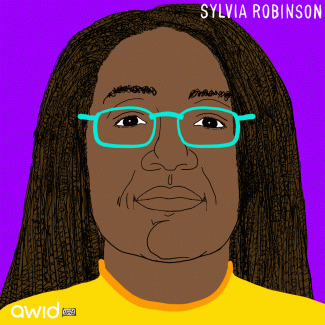
"Life is...about living in joy - waking up with purpose, feeling our creative energy, answering your calling." - Sylvia Robinson
Sylvia Robinson, a tireless community organizer and leader, was the founder and Executive Director of The Emergence Community Arts Collective (ECAC) in Washington DC.
This hub and performance space combine education, civic engagement, arts, social and spiritual services, and sustainable environmental practices. Sylvia envisioned it as a home where “there was a balance and synergy with the activities that people needed in order to sustain life.”
She was also one of the founding members of the Georgia Avenue Community Development Taskforce, a neighborhood group that works on social justice and organizing in Northwest DC to make sure the community has a voice in redevelopment and gentrification in the area.
“We're asking for affordable housing. We're asking that the small businesses that have been here for a long time don't get wiped out by new retail. We're asking for green space and space for people to get together to socialize. We're asking for streetscape improvements—better roads and lighting in the corridor.” - Sylvia Robinson about the Taskforce
Prior to becoming an organizer and after receiving a degree in computer science, Sylvia worked in air traffic control systems for over a decade. She then moved into drug and alcohol counselling, becoming increasingly engaged in community work.
“It was my call to be involved in community.” - Sylvia Robinson
Born in Washington D.C. on 14 August 1961, Sylvia passed away on 18 September 2017 after a battle with cancer.
“Sylvia's spirit and legacy will continue to inspire this community for many years to come.” - ECAC
FRMag - Freeing the Church
Freeing the Church, Decolonizing the Bible for West Papuan Women
by Rode Wanimbo
I was born and grew up in Agamua, the Central Highlands of West Papua. My father belongs to the Lani tribe and my mother comes from Walak. (...)
< artwork: “Offerings for Black Life” by Sokari Ekine
Holding up the Skies
A Film Series on Feminist Realities from Africa and the African Diaspora
by Gabrielle Tesfaye
When I created my short animation film, The Water Will Carry Us Home, my mind was plugged into a magical world of fearless resilience and ancestral mermaids who transformed their deepest scars into a new generation of life. Set during the time of the transatlantic slave trade, I was pulled to show this history of African enslavement in a different way than it has ever been told on screen. I wanted to give my ancestors the commemoration they never received. I was motivated to reclaim the history that continues to paint us as helpless victims. Essentially, I wanted to tell the truth. To reclaim and reimagine our history and perspective, means to simultaneously heal our generational traumas that exist today. It is this important work that so many women through the African continent and the African diaspora are doing today, igniting our collective Feminist Realities.
In the making of the film I researched religiously, and in what was written, I saw what was not. There were many times I felt I was hitting a wall trying to find something that was not there, and it was in those voided places that I realized the storytellers of today are filling the voids. I found the most useful stories in contemporary art, film, and African diaspora folklore.
“... a truly unique, raw and representation of feminist power in action.”
The Water Will Carry Us Home carried itself around the world into the hearts of the Diaspora. It also led me here, as the curator of the African and Diaspora film screenings of AWID’s Co-Creating Feminist Realities initiative. Whilst curating this collection of films, I looked for stories that were completely unique, raw and representational of feminist power in action. Consisting of three shorts and one feature, they reveal stories through many communities in Africa and the diaspora, including Ethiopia, Uganda, The Democratic Republic of Congo, South Africa and Kenya. These films reposition African women as what they truly are- self governing and empowered through the unfiltered lens of their work.
“An incredibly beautiful, attentive, finely observed telling of the connection between Africa and its Diaspora formed form the trans Altantic slave trade. The visual universe it creates is just gorgeous… an echo of the fusion of spiritual traditions and non-linear time that speak to how we are still experiencing the moments of the past that formed 'new' worlds of diaspora blackness.”
- Jessica Horn, PanAfrican feminst strategist, writer and co-creator of the temple of her skin
Our short documentary film, Women Hold Up the Sky, created by the WoMin African Alliance, tells the story of women activists in Uganda and the Democractic Republic of Congo who are actively reclaiming their land rights, threatened by mining and other extractives in their homes. The film not only exposes the corruption of extractivism, but finally shares what we have been missing on screen - how grassroots African women are actively organizing, strategizing, and analyzing within their communities to create women-centred and community-driven alternatives. Margaret Mapondera of WoMin explains it beautifully, that they are the “custodians of lands, forests, waters, rivers and territories; the ways in which women hold and transmit the stories / herstories of our past and our futures; the powerful and transformative ways of being that women embody in their relationships to each other, to the environment and in themselves.”
“A refreshing and much-needed piece of cinema highlighting the many ways African women are coming together to create women-led and community-driven alternatives… The fight is on and
women hold the key.”
Pumzi, created by critically acclaimed director Wanuri Kahiu, bridges Africa and science fiction around climate and environmentalism. Pumzi imagines a futuristic world where humankind has been forced to settle on another planet. While Pumzi seems afro-futuristic and new for Africa on the surface, Kahiu reveals the truth that science fiction and fantasy is something that has always existed in African storytelling, but never recognized. Kahiu creates a world where women are truth seekers and heroes who pioneer us into a new world, the opposite of images that position Africans as victims of war and destruction. Instead, Pumzi writes the narrative of African women being their own saviors and problem solvers, who stop at no cost to follow the cryptic visions they channel in their dreams.
“A pioneering African sci-fi film, situating women as scribes of the future and opening up our visions about other worlds, other universes we might occupy as Africans - always an important exercise as we imagine our way out of present crises.”
- Jessica Horn, PanAfrican feminst strategist, writer and co-creator of the temple of her skin
Our feature film of the program, Finding Sally is set in 1970’s Ethiopia during the time of The Red Terror war, documenting the striking history of director Tamara Mariam Dawit’s activist aunt, Sally Dawit. Throughout the film we learn of Sally’s incredible journey as a young and courageous woman activist navigating one of the most violent times of Ethiopian history. Sally’s story not only reveals the gravity of this time, but the reflection of her own personal evolution as a young woman. Dawit was intentional to tell the film through the lens of women, untouched by male voices. Due to so much Ethiopian history being told by men, the making of this powerful story preserved its reality of honoring the feminist perspective. Dawit explains, “Women in revolution and war are often only included as someone's spouse or someone who did cooking or typing work. I wanted to look at the activism around the revolution only through the memories and voices of women.” Finding Sally demonstrates the reclamation of history sought by current filmmakers today. It is an igniting of feminist power and our connected realities throughout time.
“The responsibility falls on us, to remember these women that came before us and their brilliant work so they are not forgotten like the thousands of women already forgotten while fighting the good fight. Sally is such a woman and may she never be forgotten.”
These films have became a part of my own psyche, empowering me to continue building powerful alternatives towards justice from within. They affirm that I am a woman among a world of women, holding up the skies and actively building indestructible Feminist Realities. These films are more than stories of African women - they are globally relatable, inspiring and set the example of Feminist Realities for all of us around the world.
Gabrielle Tesfaye:
Gabrielle Tesfaye is an interdisciplinary artist versed in painting, animation, film, puppetry and interactive installation. Her work is rooted in the African diaspora, Afro-futurism, ancient art practices and cultural storytelling.
Follow us on Social Media to receive news about upcoming events and screenings: