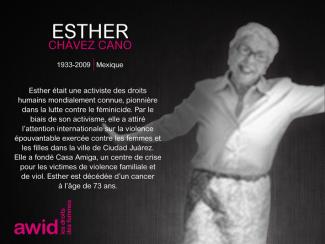
Esther Chávez Cano
Au cours des dernières années, nous avons observé une nouvelle tendance inquiétante dans les espaces internationaux consacrés aux droits humains. Les discours axés sur « la protection de la famille » sont en effet utilisés pour défendre des violations des droits de membres de la famille, pour renforcer et justifier l’impunité des auteurs de ces violations et pour restreindre l’égalité des droits au niveau de la vie familiale.
La campagne en faveur de la « Protection de la famille » est motivée par une volonté conservatrice d’imposer des conceptions « traditionnelles » et patriarcales de la famille et de priver les membres de la famille de leurs droits pour les transférer à « l’institution familiale ».
Depuis 2014, un groupe d’Etats travaille de front dans les espaces dédiés aux droits humains sous le nom de « Group of Friends of the Family » (Groupe des ami-e-s de la famille) ; des résolutions sur la « Protection de la famille » ont été adoptées chaque année depuis 2014.
Ce programme s’est propagé au-delà du Conseil des droits humains. Nous avons observé l’introduction d’un discours régressif autour de la « famille » à la Commission sur la condition de la femme, ainsi que des tentatives d’introduction dans les négociations sur les Objectifs de développement durable.
L’AWID travaille avec des partenaires et des allié-e-s pour s’opposer ensemble à la « Protection de la famille » et à d’autres programmes régressifs et défendre l’universalité des droits humains.
En réponse à l’influence croissante d’acteurs régressifs au sein des espaces dédiés aux droits humains, l’AWID a rejoint des allié-e-s afin de créer l’Observatoire sur l'Universalité des droits (OURs) (site en anglais). L’OURs est un projet de collaboration qui surveille, analyse et diffuse les informations concernant les initiatives anti-droits telles que la « Protection de la famille ».
Le premier rapport de l’OURs, Nos droits en danger, trace une cartographie des acteurs et actrices qui constituent le lobby mondial anti-droits et identifie leur réthorique et stratégies clés ainsi que leur impact sur les droits humains.
Le rapport précise que le programme de « Protection de la famille » a développé une collaboration entre un large éventail d’acteurs régressifs aux Nations Unies, qu’il décrit comme « un cadre stratégique abritant des positions anti-droits et patriarcales multiples, où le cadre vise entre autres à légitimer et institutionnaliser ces positions. »
Tout à fait, ces questions sont facultatives, et nous reconnaissons votre droit à l’anonymat. Merci de répondre aux questions de l’enquête, peu importe votre décision quant à la mention du nom de votre groupe, organisation et/ou mouvement et de vos coordonnées.
In our 2015 Online Tribute to Women Human Rights Defenders No Longer With Us we are commemorating four women from Sub-Saharan Africa, three of whom were murdered due to their work and/or who they were in their gender identity and sexual orientation. Their deaths highlight the violence LGBT persons often face in the region and across the globe. Please join AWID in honoring these women, their activism and legacy by sharing the memes below with your colleagues, networks and friends and by using the hashtags #WHRDTribute and #16Days.
Please click on each image below to see a larger version and download as a file


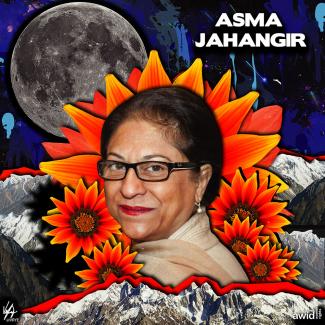
Asma was a leading Pakistani rights activist, fearless critic of the military’s interference in politics and a staunch defender of the rule of law.
She was the founding chairwoman of the Human Rights Commission of Pakistan, an independent group, and was a trustee of the International Crisis Group. She won international awards and served as the United Nations rapporteur on human rights and extrajudicial killings.
She is remembered fondly by colleagues and friends at AWID
“With her life, Asma rewrote the history that many of us were told as women. Asma changed the world. She changed it in Pakistan, and she changed it in our imaginations."
Yes, please do! We encourage you to share the survey link with your networks. The more diverse perspectives we gather, the more comprehensive our understanding of the financial landscape for feminist organizing will be.
In 2013, we published three global reports. These reports confirm that women’s rights organizations are doing the heavy lifting to advance women’s rights and gender equality by using diverse, creative and long-term strategies, all while being underfunded.
Our 2010 global survey showed that the collective income of 740 women’s organizations around the world totaled only USD 104 million. Compare this with Greenpeace International, one organization with a 2010 budget of USD 310 million1. Imagine the impact these groups could have if they were able to access all the financial resources they need and more?
AWID’s WITM research has catalyzed increased funding for women’s rights organizing. WITM research was a driving force behind the Catapult crowdfunding platform, which has raised USD 6.5 million for women’s rights. The Dutch Government cited WITM research as a reason for its unprecedented MDG 3 Fund of EU 82 million. WITM research has also led to the creation of several new funds: FRIDA – The Young Feminist Fund, the Indigenous Women’s Fund, Fundo Elas, the Mediterranean Women’s Fund and the Rita Fund.
While the WITM research has shed important light on the global funding landscape, AWID and partners have identified the need to dig deeper, to analyze funding trends by region, population and issue. In response, organizations are now using AWID’s WITM research methodology to do their own funding trends analyses. For example, in November 2013, Kosova Women’s Network and Alter Habitus – Institute for Studies in Society and Culture published Where is the Money for Women’s Rights? A Kosovo Case Study.
At the same time, AWID continues to collaborate with partners in Where is the Money for Indigenous Women’s Rights (with International Indigenous Women’s Forum and International Funders for Indigenous Peoples) and our upcoming Where is the Money for Women’s Rights in Brazil? (with Fundo Elas).
Several organizations have also conducted their own independent funding trends research, deepening their understanding of the funding landscape and politics behind it. For example, the South Asian Women’s Fund was inspired by AWID’s WITM research to conduct funding trends reports for each country in South Asia, as well as a regional overview. Other examples of research outside of AWID include the collaboration between Open Society Foundations, Mama Cash, and the Red Umbrella Fund to produce the report Funding for Sex Workers Rights, and the first-ever survey on trans* and intersex funding by Global Action for Trans* Equality and American Jewish World Service.
Nous Sommes la Solution élève et développe le leadership des femmes rurales travaillant à des solutions africaines pour la souveraineté alimentaire.
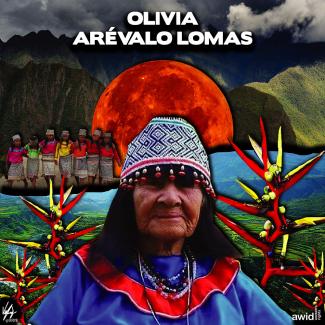
Olivia era la líder espiritual del pueblo indígena Shipibo Konibo.
Sabia mujer indígena y abuela, era conocida por practicar la medicina tradicional y cantar las canciones sagradas de su pueblo (Íkaros). Olivia Arévalo fue una activa defensora de los derechos culturales y ambientales de su pueblo. Su asesinato tuvo lugar en un contexto de conflicto territorial entre la comunidad shipibo y las empresas que quieren apropiarse de sus tierras para cultivar palma aceitera.
Integrantes de su comunidad han dicho: «Su muerte es una agresión contra toda la comunidad shipibo. Ella era la memoria viviente de su pueblo».
Now that you have analyzed all your data – from your survey, interviews, desk research and potentially other sources – you can create your final product.
In this section:
- Create your final product
1. Write clearly
2. Make it pretty- Gather review and inputs
1. Polish your results
2. Facilitate the feedback
Your final product will be the document that will summarize, analyze and criticize your data. That will be the piece that you will share with your community to present and explain your research to your audience.
At AWID, we often write a comprehensive written report that analyzes each set of data and synthesizes all of our findings, then later create smaller products, such as infographics and summaries (explained in the subsequent section “Finalize and format”).
Importance of the editor
An editor will proofread, ensure concise writing, conduct fact-checking, point out inconsistencies that need to be resolved, arrange the flow of the document and possibly suggest titles.
Your editor should preferably be someone who understands and knows your WITM work but who was not directly involved in the research. This will bring in a fresh perspective.
Use the data collected to create graphs and tables. These type of visuals are a compelling way to highlight the main findings of your research and validate your analysis.
Source relevant images that can illustrate your report.
Highlight key-numbers and/or powerful testimonials.
Remember: The more accessible your product is, the more people will want to read (and share!) it.
At this point, you have collected all your data, analyzed it and transformed it into your final product, likely in a long report.
Before moving on to the next steps – you should share your final research product with your advisor organizations, activists, and donors.
This is a great moment to check the following points:
Once you have inputted all feedback from your advisors, be sure to run it by your editor once more.
This will now be the final, completed version of your report. If you intend to publish the final report in other languages, now is the time to send it for translation.
This is a significant contribution from your advisors. Consider offering them some form of recognition.

• 2 - 5 months
• 1 or more research person(s)
• 1 Editor (or web-editor if you create an online product)
• Translator(s), if done in more than one language
• List of advisor organizations, activists, and donors.
• Concept note (from “Frame your research” section)
• Survey topline results
• Prepared interview questions
• Interview results
• Desk research data
• All other data used in report
A workplace does not have to operate on competition and profit. It does not have to exploit people for the benefit of the owner and a small elite either.
Instead, communities on the margins of formal economies are building cooperative models based on autonomy, cooperation, shared responsibility, self-management and solidarity.
Worker-controlled cooperatives and workplaces have always offered alternative ways of generating employment opportunities, income, social security and savings - while distributing revenues in more communal, sustainable and safer ways.
But it is more than an employment opportunity: it is the making of dreams into a reality, and the building of feminist economies based on solidarity and care for each other. It is about creating a world where our lives, our labor and our communities matter.
This is the story of the Nadia Echazú Textile Cooperative, the first social enterprise managed by and for travesti and trans people in Argentina.
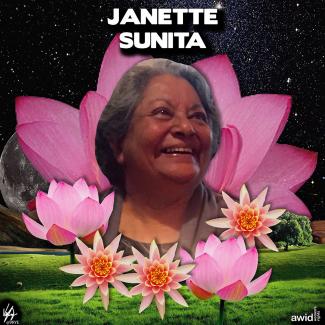
Originaire d'Inde, Janette était une personne formidable, fougueuse, bienveillante et aimante.
Son intolérance à l’égard de l’injustice et sa ferme volonté de défendre les droits de toutes les personnes l’ont amenée à travailler pour TARSHI (une ONG qui travaille sur la sexualité et la santé sexuelle et reproductive) pendant plus de 15 ans. Janette a géré et dirigé avec compétence les aspects financiers, les ressources humaines et les aspects opérationnels de TARSHI, naviguant adroitement dans la bureaucratie labyrinthique à laquelle sont soumises les ONG indiennes.
Son équipe se souvient « elle assurait nos arrières pour que nous puissions naviguer en eaux libres. Femme aux multiples talents, Janette nous a non seulement aidés à acquérir nos propres bureaux, mais elles les a également aménagés pour leur utilisation optimale. Elle aimait les voyages et les animaux et s'intéressait à la thérapie assistée par les animaux ».


Опрос доступен на английском, арабском, испанском, португальском, русском и французском языках!