La memoria como resistencia: Un Tributo
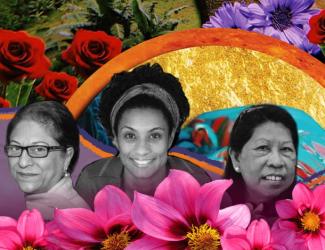
El Tributo de AWID es una exhibición de arte que honra a feministas, a activistas por los derechos de las mujeres y de la justicia social de todo el mundo que ya no están con nosotrxs.
En 2020, hacemos un cambio
El Tributo de este año cuenta y comparte las historias y narraciones de quienes crearon conjuntamente realidades feministas, ofrecieron visiones de alternativas a los sistemas y actores que nos oprimen, y propusieron nuevas formas de organizarnos, de movilizarnos, de luchar, de trabajar, de vivir y de aprender.
Se agregan a la galería 49 retratos nuevos de feministas y defensorxs de derechos humanos. Aunque muchxs feministas y defensorxs han fallecido debido a edad avanzada o enfermedad, muchísimxs han sido asesinadxs debido a su trabajo y por ser quienes eran.
Esta violencia creciente (de parte de Estados, empresas transnacionales, crimen organizado, sicarios no identificados, etc.) no se dirige solo a activistas individuales sino a nuestro trabajo común y a las realidades feministas.
Al compartir las historias de lxs activistas en este Tributo, mantenemos vivo su legado y nos inspiran para el trabajo futuro de nuestros movimientos.
Visita nuestra exhibición en línea
Lors retratos de 2020 fueron diseñados por la ilustradora y animadora galardonada, Louisa Bertman.
En AWID nos gustaría agradecer a las familias y organizaciones que nos compartieron sus historias personales, y así haber contribuido a este memorial. Nos unimos a ellxs para continuar el extraordinario trabajo de estxs activistas y defensorxs, y en el esfuerzo para asegurarnos de que se logre justicia en los casos que permanecen en la impunidad
"Ellos trataron de enterrarnos pero no sabían que éramos semillas."‐ Proverbio Mexicano
Presentamos el Tributo por primera vez en 2012
Primero tomó forma como una exposición física de retratos y biografías de feministas y activistas que habían fallecido, en el 12º Foro Internacional de AWID, en Turquía. Ahora vive como una galería en línea, que actualizamos cada año.
Desde 2012 hemos presentado más de 467 feministas y defensorxs.
Contenido relacionado
Key opposition discourses
Ultra conservative actors have developed a number of discourses at the international human rights level that call on arguments manipulating religion, culture, tradition, and national sovereignty in order to undermine rights related to gender and sexuality.
Anti-rights actors have increasingly moved away from explicitly religious language. Increasingly, we see regressive actors - who may previously have derided human rights concepts - instead manipulating and co-opting these very concepts to further their objectives.
Protection of the family
This emerging and successful discourse appears innocuous, but it functions as a useful umbrella theme to house multiple patriarchal and anti-rights positions. The ‘protection of the family’ theme is thus a key example of regressive actors’ move towards holistic and integrated advocacy.
The language of ‘protection of the family’ works to shift the subject of human rights from the individual and onto already powerful institutions.
It also affirms a unitary, hierarchical, and patriarchal conception of the family that discriminates against family forms outside of these rigid boundaries. It also attempts to change the focus from recognition and protection of the rights of vulnerable family members to non-discrimination, autonomy, and freedom from violence in the context of family relations.
The Right to Life
The Holy See and a number of Christian Right groups seek to appropriate the right to life in service of an anti-abortion mission. Infusing human rights language with conservative religious doctrine, they argue that the right to life, as set out in the Universal Declaration of Human Rights and the International Covenant on Civil and Political Rights, applies at the moment of conception.
The discourse has no support in any universal human rights instrument. Yet this is an appealing tactic for anti-rights actors, because the right to life cannot be violated under any circumstances and is a binding legal standard.
Sexual rights
Anti-rights actors use a number of rhetorical devices in their campaign to undermine sexual rights: they argue that sexual rights do not exist or are ‘new rights,’ that they cause harm to children and society, and/or that these rights stand in opposition to culture, tradition or national laws.
Conservative actors engaged in advocacy at the UN attack the right to comprehensive sexuality education from several directions. They claim that CSE violates ‘parental rights’, harms children, and that it is not education but ideological indoctrination. They also claim that comprehensive sexuality education is pushed on children, parents, and the United Nations by powerful lobbyists seeking to profit from services they provide to children and youth.
Attempts to invalidate rights related to sexual orientation and gender identity have proliferated. Ultra conservative actors argue that application of long-standing human rights principles and law on this issue constitutes the creation of ‘new rights’; and that the meaning of rights should vary radically because they should be interpreted through the lens of ‘culture’ or ‘national particularities.’
Reproductive Rights
Christian Right organizations have been mobilizing against reproductive rights alongside the Holy See and other anti-rights allies for several years. They often argue that reproductive rights are at heart a form of Western-imposed population control over countries in the global South. Ironically, this claim often originates from U.S. and Western Europe-affiliated actors, many of whom actively work to export their fundamentalist discourses and policies.
Regressive actors also cite to ‘scientific’ arguments from ultra-conservative think tanks, and from sources that rely on unsound research methodologies, to suggest that abortion causes an array of psychological, sexual, physical, and relational side effects.
Protection of children and parental rights
Just as anti-rights actors aim to construct a new category of ‘protection of the family,’ they are attempting to construct a new category of ‘parental rights,’ which has no support in existing human rights standards.
This discourse paradoxically endeavours to use the rights protections with which children are endowed, as articulated in the Convention on the Rights of the Child, to support the rights of parents to control their children and limit their rights.
Violence against women
Increasingly, anti-rights actors are attempting to infiltrate and subvert standards and discourses developed by women human rights defenders, such as violence against women (VAW).
At the Commission on the Status of Women and other spaces, one rhetorical move is to treat VAW as a concept in which to embed anti-reproductive rights and patriarchal arguments. Ultra conservative actors, for example, have argued that non-heteronormative or traditional intimate partner relationships are a risk factor for violence, and emphasize that fathers are necessary to protect families from violence.
Gender and ‘gender ideology’
The Holy See has set off a sustained critique of gender, ‘gender ideology’, ‘gender radicals,’ and gender theory, and anti-rights actors often read the term as code for LGBTQ rights. Gender is used by the religious right as a cross-cutting concept that links together many of their discourses. Increasingly, the hysteria on this subject fixates on gender identity and trans rights.
Complementarity and human dignity
Complementarity of the sexes is a discourse employed by a number of ultra-conservative actors today. Its rhetoric is structured around an assumption of difference: men and women are meant to have differing but complementary roles in marriage and family life, and with respect to their engagement in the community and political and economic life.
Reference to ‘natural’ roles is meant to fundamentally reject universal human rights to equality and non-discrimination.
It is also used to justify State and non-State violations of these rights, and non-compliance with respect to State obligations to eliminate prejudices and practices based on stereotyped roles for men or women.
National sovereignty and anti-imperialism
This discourse suggests that national governments are being unjustly targeted by UN bodies, or by other States acting through the UN. This is an attempt to shift the subject of human rights from the individual or marginalized community suffering a rights violation to a powerful and/or regressive institution - i.e. the state, in order to justify national exceptions from universal rights or to support state impunity.
Religious freedom
Anti-rights actors have taken up the discourse of freedom of religion in order to justify violations of human rights. Yet, ultra-conservative actors refer to religious freedom in a way that directly contradicts the purpose of this human right and fundamentally conflicts with the principle of the universality of rights. The inference is that religious liberty is threatened and undermined by the protection of human rights, particularly those related to gender and sexuality.
The central move is to suggest that the right to freedom of religion is intended to protect a religion rather than those who are free to hold or not hold different religious beliefs.
Yet under international human rights law, the right protects believers rather than beliefs, and the right to freedom of religion, thought and conscience includes the right not to profess any religion or belief or to change one’s religion or belief.
Cultural rights and traditional values
The deployment of references to culture and tradition to undermine human rights, including the right to equality, is a common tactic amongst anti-rights actors. Culture is presented as monolithic, static, and immutable, and it is is often presented in opposition to ‘Western norms.’
Allusions to culture by anti-rights actors in international policy debates aim to undermine the universality of rights, arguing for cultural relativism that trumps or limits rights claims. Regressive actors’ use of cultural rights is founded on a purposeful misrepresentation of the human right. States must ensure that traditional or cultural attitudes are not used to justify violations of equality, and human rights law calls for equal access, participation and contribution in all aspects of cultural life for all, including women, religious, and racial minorities, and those with non-conforming genders and sexualities.
Subverting ‘universal’
Anti-rights actors in international policy spaces increasingly manipulate references to universal or fundamental human rights to reverse the meaning of the universality of rights.
Rather than using the term universal to describe the full set of indivisible and interrelated human rights, ultra conservative actors employ this term to instead delineate and describe a subset of human rights as ‘truly fundamental.’ Other rights would thus be subject to State discretion, ‘new’ rights or optional. This discourse is especially powerful as their category of the truly universal remains unarticulated and hence open to shifting interpretation.
Other Chapters
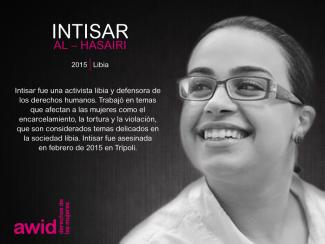
Intisar Al-Hasairi
Navleen Kumar
« Ce n’était pas une personne. C’était une puissance », compagnes et compagnons de lutte se souvenant de Navleen Kumar
Née le 15 octobre 1948, Navleen Kumar était une fervente militante pour la défense des droits fonciers et de la justice sociale en Inde.
Avec implication et intégrité, elle a œuvré pendant plus d’une décennie à la protection et la restitution des terres aux populations autochtones (les adivasi) dans le district de Thane, une région confisquée sous le régime de la force et de l’intimidation par les promoteurs immobiliers et fonciers. Elle a combattu cette injustice et ces crimes en menant des procédures juridiques au niveau de différents tribunaux, réalisant que la manipulation des registres fonciers était une opération courante dans la plupart des acquisitions de terres. Dans l’un de ces cas, celui des Wartha (une famille tribale), Navleen a entre autres découvert que la famille avait été dupée avec la complicité de fonctionnaires du gouvernement.
Grâce à son travail, elle a aidé les Wartha à récupérer leurs terres, de même que continué à défendre plusieurs affaires de transferts de terres d’adivasi.
« Son rapport sur l’impact de l’aliénation des terres sur les femmes et les enfants adivasi retrace l’histoire et les complexités de l’aliénation tribale depuis les années 1970, alors que les familles de la classe moyenne ont commencé à venir vivre dans les banlieues éloignées de Mumbai, suite à la hausse des prix de l’immobilier dans la ville.
Les complexes immobiliers se sont multipliés dans ces banlieues, et les tribus analphabètes en ont payé le prix. Les meilleures terres le long de la voie de chemin de fer valaient cher et les constructeurs se sont jetés dessus comme des vautours, pour arracher les terres des tribus et autres résidents locaux par des moyens illégaux », Jaya Menon, Justice and Peace Commission.
Au cours de ses actions militantes, Navleen a reçu de nombreuses menaces et survécu à plusieurs tentatives d’assassinat. Malgré tout, elle a continué son travail sur ce qui était non seulement important à ses yeux mais qui contribuait à transformer les vies et les réalités de tant de personnes qu’elle soutenait dans sa lutte pour la justice sociale.
Navleen a été poignardée à mort dans son immeuble le 19 juin 2002. Deux gangsters locaux ont été arrêtés pour son meurtre.
Como é que os dados recolhidos através do questionário serão divulgados e processados?
Os dados serão processados para fins estatísticos para esclarecer o estado de financiamento dos movimentos feministas globalmente e serão divulgados apenas em forma agregada. A AWID não divulgará informações sobre uma organização específica ou informações que permitam identificar uma organização através da respetiva localização ou características sem o respetivo consentimento comprovado.
Snippet FEA collaborator and allies Photo 5 (FR)
When development initiatives, religious fundamentalisms and the state of women’s rights collide
Nuestro nuevo documento de investigación El diablo se esconde en los detalles aborda la falta de conocimientos sobre los fundamentalismos religiosos en el sector del desarrollo, y se propone comprender mejor de qué manera estos fundamentalismos inhiben el desarrollo y, en particular, los derechos de las mujeres. Propone recomendaciones para que quienes trabajan en temas de desarrollo desafíen la labor de los fundamentalismos y eviten fortalecerlos inadvertidamente. [CTA download link: Leer el documento completo]
Seven pointers to consider
| Graphic1 | 1. Control of women’s bodies, sexuality, and choice are “warning signs” of rising fundamentalisms. |
| 2. Neoliberal economic policies have a particularly negative impact on women, and fuel the growth of religious fundamentalisms. | Graphic2 |
| Graphic3 | 3. Choosing religious organizations as default for partnerships builds their legitimacy and access to resources, and supports their ideology, including gender ideology. |
| 4.Everyone has multiple identities and should be defined by more than just their religion. Foregrounding religious identities tends to reinforce the power of religious fundamentalists. | Graphic4 |
| Graphic5 | 5. Religion, culture, and tradition are constantly changing, being reinterpreted and challenged. What is dominant is always a question of power. |
| 6. Racism, exclusion, and marginalization all add to the appeal of fundamentalists’ offer of a sense of belonging and a “cause”. | Graphic6 |
| Graphic7 | 7. There is strong evidence that the single most important factor in promoting women’s rights and gender equality is an autonomous women’s movement. |
Auge global de los fundamentalismos religiosos.
El Diablo se esconde en los detalles proporciona detalles de las graves violaciones a los derechos humanos y, en particular, de las violaciones a los derechos de las mujeres, causados por los fundamentalismos auspiciados por los Estados, así como por actores fundamentalistas no estatales como milicias, organizaciones comunitarias confesionales e individuos. La profundización fundamentalista de normas sociales atávicas y patriarcales está provocando el aumento de la violencia contra las mujeres, las niñas y las defensoras de derechos humanos (WHRDs). El informe propuesta estas ideas clave para abordar el problema:
- [icon] Fundamentalismos religiosos están ganando terreno en el seno de las comunidades
- [icon] Sistemas políticos
- [icon] Escenarios internacionales, con efectos devastadores para la gente común y para las mujeres en particular.
Los agentes de desarrollo deben actuar urgentemente.
Quienes trabajan en el desarrollo están de capacidad de asumir una posición más firme. Su capacidad colectiva para reconocer y enfrentar conjuntamente a los fundamentalismos religiosos resulta crucial para promover la justicia social, económica y de género y los derechos humanos de todas las personas en el marco del desarrollo sostenible. Resulta fundamental promover que el poder y los privilegios se entiendan desde la óptica del feminismo interseccional y aplicar esta comprensión a los interrogantes sobre religión y cultura. Las organizaciones de mujeres ya poseen conocimientos y estrategias para oponerse a los fundamentalismos. Quienes trabajan en el desarrollo deberían apoyarse en estos e invertir en coaliciones enfocadas en múltiples temáticas. Lo anterior, les ayudará a alcanzar nuevos horizontes.
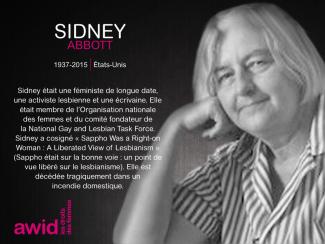
Sidney Abbott
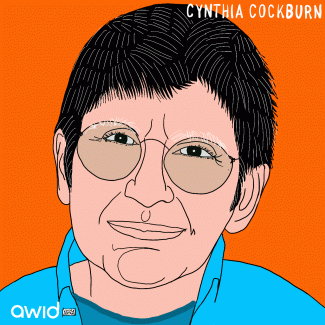
Cynthia Cockburn
Cynthia Cockburn was a feminist sociologist, writer, academic, photographer and peace activist.
She explored the gendered aspects of violence and conflict and made significant contributions to the peace movement through her exploration of the themes of masculinity and violence as well as her local and international activism.
Cynthia brought a feminist power analysis to militarisation and war, and was among the academics whose writings and analysis clearly demonstrated how gender-based violence played a key part in perpetuating war. Working closely with peace activists in countries experiencing conflict, her findings covered diverse contexts including Northern Ireland, Bosnia-Herzegovina, Israel/Palestine, South Korea, Japan, Spain and the UK. She helped bring in her research and academic writings, an understanding that violence was experienced as a continuum of time and scale and perceived very differently when seen from a gendered lens.
In her words, “Gender helps us to see the continuity, the connection between instances of violence.”
Cynthia bridged her research with the activism she did locally and internationally with movements for demilitarisation, disarmament and peace. She helped start the Greenham Common women’s peace camp, which advocated for universal nuclear disarmament in Britain and was part of establishing the London chapter of Women in Black.
Over the decades, Cynthia organized and participated in local weekly vigils and the political choir Raised Voices, singing in the choir, and writing several of the lyrics to the songs that have made up its repertoire. She was also active in the Women’s International League for Peace and Freedom (WILPF), the European Forum of Socialist Feminists as well as in Women Against Fundamentalism.
“Cynthia shed feminist light, wove together feminist communities, sang songs of peace, listened, listened, listened, watched the birds – and stopped traffic. I’ll be forever and gratefully in her debt, the other ‘Cynthia’” – Cynthia Enloe
Cynthia was born in July 1934 and passed away in September 2019 at the age of 85.
حالة التمويل للحركات النسوية ووقائعها تتغير بسرعة. هل هذا الاستطلاع لمرة واحدة؟
كلا. يبني هذا الاستطلاع على المعلومات التي حشدتها جمعية حقوق المرأة في التنمية حول كيفية الحصول على تمويل أكبر وأفضل للحركات النسوية وحركات التغيير الاجتماعي وهذه الدورة الثالثة لاستطلاع "أين التمويل للتنظيمات النسوية". نهدف للقيام بالاستطلاع مرة كل ثلاثة أعوام.
Snippet FEA Workers Persecution S4 (EN)

WORKERS PERSECUTION
Here is your Feminist Realities Toolkit
Thank you for taking the first steps to Co-create Feminist Realities!
Learn more about Feminist Realities
Any questions? Please do not hesitate to contact us
The Feminist Realities Magazine
The Feminist Realities Magazine
We bring you an inspiring curated collection of powerful stories and images of transformation and resistance created by feminist activists, writers and artists from all over the world.
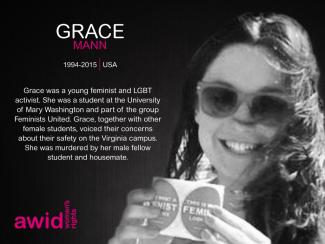
Grace Mann
Hevrin Khalaf
Hevrin Khalaf fue una destacada líder política siria-kurda de la región autónoma de Rojava, donde las mujeres kurdas están arriesgando sus vidas para resistir la ofensiva turca y construir un sistema feminista.
Hevrin fue Secretaria General del Future Syria Party [Partido de la Futura Siria] (FSP, por sus siglas en inglés), un grupo que tenía como objetivo la construcción de puentes, la reconciliación entre diferentes grupos étnicos y el trabajo hacia una "Siria democrática, pluralista y descentralizada".
Hevrin fue un símbolo de este esfuerzo de reconciliación. También trabajó para promover la igualdad entre mujeres y hombres y fue una representante para periodistas, trabajadorxs de ayuda humanitaria y diplomáticxs que visitaban la región.
Hevrin era también una ingeniera civil de Derik, y fue una de las fundadoras de Foundation for Science and Free Though [(Fundación para la Ciencia y el Libre Pensamiento] en 2012.
El 12 de octubre de 2019 fue torturada y asesinada por la milicia Ahrar al-Sharqiya, sustentada por Turquía, durante una operación militar contra las Fuerzas Democráticas Sirias en Rojava.
"El asesinato de Khalaf es un punto de inflexión en la historia moderna de Siria. Demuestra una vez más el viejo proverbio kurdo "no hay amigxs sino montañas". Siempre seré amigo[NC1] de Khalaf y su visión de un mundo mejor." - Ahed Al Hendi
Snippet - WITM Who should - PT
Quem deve realizar este inquérito?
O inquérito destina-se a grupos, organizações e movimentos que trabalham especificamente ou principalmente pelos direitos das mulheres, pessoas LBTQI+ e pela justiça de género, em todos os contextos, em todos os níveis e em todas as regiões. Se este for um dos pilares principais do seu grupo, da sua comunidade, da sua rede ou de qualquer outro tipo de organização, quer esteja registada ou não, seja nova ou já estabelecida, convidamo-lo a participar neste inquérito.

* De momento, não solicitamos respostas de indivídues ou de fundos feministas e de mulheres.
Snippet FEA HEALTH CONDITIONS (ES)