None On Record

Special Focus

AWID is an international, feminist, membership organisation committed to achieving gender equality, sustainable development and women’s human rights

Young Feminist Activism

Organizing creatively, facing an increasing threat

Young feminist activists play a critical role in women’s rights organizations and movements worldwide by bringing up new issues that feminists face today. Their strength, creativity and adaptability are vital to the sustainability of feminist organizing.

At the same time, they face specific impediments to their activism such as limited access to funding and support, lack of capacity-building opportunities, and a significant increase of attacks on young women human rights defenders. This creates a lack of visibility that makes more difficult their inclusion and effective participation within women’s rights movements.

A multigenerational approach

AWID’s young feminist activism program was created to make sure the voices of young women are heard and reflected in feminist discourse. We want to ensure that young feminists have better access to funding, capacity-building opportunities and international processes. In addition to supporting young feminists directly, we are also working with women’s rights activists of all ages on practical models and strategies for effective multigenerational organizing.

Our Actions

We want young feminist activists to play a role in decision-making affecting their rights by:

  • Fostering community and sharing information through the Young Feminist Wire. Recognizing the importance of online media for the work of young feminists, our team launched the Young Feminist Wire in May 2010 to share information, build capacity through online webinars and e-discussions, and encourage community building.

  • Researching and building knowledge on young feminist activism, to increase the visibility and impact of young feminist activism within and across women’s rights movements and other key actors such as donors.

  • Promoting more effective multigenerational organizing, exploring better ways to work together.

  • Supporting young feminists to engage in global development processes such as those within the United Nations

  • Collaboration across all of AWID’s priority areas, including the Forum, to ensure young feminists’ key contributions, perspectives, needs and activism are reflected in debates, policies and programs affecting them.

Related Content

Nous redistribuons une partie de nos fonds à des partenaires bénéficiaires et nous identifions comme un fonds féministe et/ou de femmes, devrions-nous participer à cette enquête?

Non, nous reconnaissons l’importance cruciale de votre travail, mais nous ne collectons pas les participations de fonds féministes et de femmes à l’heure actuelle. Nous vous encourageons néanmoins à transmettre cette enquête à vos partenaires bénéficiaires et vos réseaux féministes.

Snippet FEA Ecofeminism (ES)

África del Oeste

NOUS SOMMES LA SOLUTION
Somos la Solución


ECOFEMINISMO:

El respeto por todo lo que nos rodea

Escribí un artículo sobre un asunto relacionado con los derechos de las mujeres y el desarrollo. ¿Cómo puedo compartirlo con la membresía de AWID?

Trans* rights require stronger protection

These transgender women were murdered because of their activism and their gender identity. There are insufficient laws recognizing trans* rights, and even where these laws exist, very little is being done to safeguard the rights of trans* people. Please join AWID in honoring these defenders, their activism and legacy by sharing the memes below with your colleagues, networks and friends and by using the hashtags #WHRDTribute and #16Days.


Please click on each image below to see a larger version and download as a file 


Asma Jahangir

Asma était une militante pakistanaise des droits humains, une critique courageuse de l'ingérence de l'armée dans la politique et une défenseure acharnée de la primauté du droit.

Elle a été la présidente fondatrice de la Commission des droits de l'homme du Pakistan, un groupe indépendant ainsi qu’administratrice de l'International Crisis Group. Elle a remporté des prix internationaux et a été rapporteuse des Nations Unies sur les droits de l'homme et les exécutions extrajudiciaires.

Ses collègues et ami-e-s de l’AWID se souviennent d'elle avec affection

« Grâce à sa vie, Asma a réécrit l'histoire que beaucoup d'entre nous ont racontée en tant que femmes. Asma a changé le monde. Elle l'a changé au Pakistan et elle l'a changé dans notre imaginaire. »


Asma Jahangir, Pakistan

What are the WITM official survey languages?

For now, the survey on KOBO is available in Arabic, English, French, Portuguese, Russian and Spanish. You will have the chance to select your language of choice at the beginning of the survey.

Snippet FEA Mariama Sonko (ES)

Tenemos el placer de presentarte a Mariama Sonko, inspiradora ecofeminista, campesina y defensora de los derechos humanos y de las mujeres, que vive actualmente en Niaguis, en el suroeste de Senegal.

Al crecer en una familia y comunidad campesina rural, fue testigo del papel esencial de la mujer en la producción de alimentos y el almacenamiento de semillas desde la infancia, mientras estaba inmersa en el trabajo y ritmos de la tierra.

Mariama ha defendido el conocimiento agrícola local y las prácticas campesinas desde los años 1990. Como madre de 5 hijos, los alimentos que ella misma cultiva son la principal fuente de sustento de su familia.

Actualmente es presidenta de Nous Sommes la Solution y está comprometida con la promoción de las prácticas agroecológicas y la agricultura familiar, con el fomento de la soberanía alimentaria, la biodiversidad y la preservación de las semillas campesinas, y con la exigencia del acceso equitativo a los recursos y a la tierra en África Occidenta para las mujeres.

Fuente: AWID’s Feminist Realities Festival Crear | Résister | Transform - 2º día

2003: le premier Dialogue de haut niveau a lieu

Premier Dialogue de haut niveau sur le financement du développement, 29-30 octobre 2003.

Les  dialogues de haut niveau  de l’Assemble générale des Nations Unies sur le financement du développement, tenus tous les deux ans, sont l’un des mécanismes de suivi de la Conférence de Monterrey. À la suite de ce premier dialogue, huit tables rondes ont été organisées  autour de différentes questions comprenant les subventions agricoles, le commerce, l’allègement de la dette et le financement des OMD. Toutes les discussions se concentraient sur les manières de faire face aux  obstacles structurels qui pesaient sur ces questions et défavorisaient  les nations « en développement ».

D'autres mécanismes de suivi de la Conférence de Monterrey :

  • Les réunions spéciales de haut niveau du Conseil économique et social des Nations Unies (ECOSOC)  tenues  chaque année sur le thème du suivi du Consensus de Monterrey et sous la direction  de la Banque mondiale, du Fonds monétaire international, de l’Organisation mondiale du commerce et de la CNUCED. En outre, au cours de chacune de ses sessions de fond, l’ECOSOC consacre jusqu’à deux jours à des  délibérations portant sur les priorités du FdD.
  • L’organe des Nations Unies consacré aux questions fiscales, le Comité d'experts de la coopération internationale en matière fiscale, traite des différentes questions relatives aux politiques fiscales qui ont été identifiées dans le Consensus de Monterrey. Il constitue un cadre de dialogue visant à améliorer et à encourager la coopération fiscale internationale entre les autorités fiscales nationales.

1. Gather your resources

This section highlights key resources recommended by AWID so you can conduct your own WITM research.

In this section

People needed

  • 1 or more person(s) to lead overall implementation of research methodology and ensure all key pieces are on track (Sections 2-11)
  • 1 or more person(s) to conceptualize the key research objectives and guiding questions
  • 1 or more person(s) to refine and conduct the research methodology, including collecting data
  • 1 or more person(s) to conduct relevant qualitative and quantitative analysis of collected data
  • 1 or more person(s) to document and package research findings for desired audience(s)
  • 1 or more person(s) to serve as an editor to your final products
  • 1 or more person(s) to conduct outreach to spread the word about your survey and advocacy using your research results

Back to top


Potential expenses

  1. Staff and/or consultant salaries
  2. Data analysis software if conducting analysis of large dataset in-house. Options:
    - SPSS
    - Stata
    - R (this is free)
  3. Cost of producing publications and research products
  4. If desired, incentive prize that survey participants can win if they complete the survey
  5. If desired, incentives to offer your advisors

Back to top


Estimated time

  • For research process: 6 to 18 months, depending on size of dataset(s) and staff capacity
  • For advocacy: 1-2 years, as determined by your organizational goals

Back to top


Resources needed

  • List of advisor organizations, donors and activists
  • List of online spaces and events/networks to distribute your survey and present your survey results
  • List of donors, activists, and women’s rights organizations to interview
  • Prepared interview questions
  • List of publication sources to use for desk research

Back to top


Resources available

Online tools

Once you gather these resources, you can estimate the costs for your research using our “Ready to Go? Worksheet”

Back to top


Previous step

Before you begin

Next step

2. Frame your research


Previous step

Before you begin

Next step

2. Frame your research


The Ready to Go? Worksheet helps you estimate resources, staff and budget needed for your research

Download the toolkit in PDF

Deborah Holmes

At the time of her death, following a short but aggressive battle with cancer, Deborah was the Chief Communication and Engagement Officer at the Women’s Funding Network (WFN). 

Deborah also worked for the Global Fund for Women from 2008 to  2017. Deborah was extremely loved and respected by board, staff, and partners of Global Fund for Women.

Kavita Ramdas, former CEO of the Global Fund for Women aptly noted that Deborah was “a small package exploding with warmth, generosity, intelligence, style, and a passionate commitment to fusing beauty with justice. She understood the power of story. The power of women’s voice. The power of lived experience. The power of rising from the ashes and telling others it was possible. And, still we rise.”

Musimbi Kanyoro, the present CEO of the Global Fund for Women, added, “We have lost a sister and her life illuminates values that unite and inspire us all. As we all come together to mourn Deborah’s passing, let us remember and celebrate her remarkable, bold, and passionate life.”


Deborah Holmes, USA

¿Debería prepararme de alguna forma para responder la encuesta?

Dado que la encuesta ¿Dónde está el dinero? se centra en las realidades de la dotación de recursos para las organizaciones feministas, la mayoría de las preguntas indagan acerca del financiamiento de tu agrupación entre 2021 y 2023. Para responder la encuesta, necesitarás tener a mano cierta información como, por ejemplo, presupuestos anuales y las fuentes clave de financiamiento.

Snippet FEA Objectives NSS Advocacy (FR)

LE PLAIDOYER

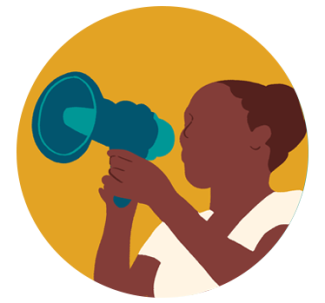
Yellow circle with illustration of a brown woman with a white t-shirt holding a blue loudspeaker.
Influencer les politiques et promouvoir un accès plus équitable à la terre pour les femmes travaillant dans l'agriculture

2011: The fifth High-level dialogue kick starts Post-2015 discussions

The Fifth High- Level Dialogue on Financing for Development, 7 – 8 December 2011, marked the beginning of the Post 2015 development agenda discussions, and the link to financing for development. The conference gave a special focus to increasing aid to finance the MDG’s. In his closing remarks, the Secretary General called on members to begin to consider the post-2015 development framework. 

5. Conduct interviews

Interviews produce in-depth information that you cannot easily obtain from surveys. While surveys focuses mainly on quantifiable data and closed questions, interviews allow for expert opinions from activists and donors, and open-ended questions which can provide context to survey data results.

In this section

General tips

1. Before conducting your interviews

Send the interviewees a concept note with your objectives for the interview and for your overall research, as well as a list of questions.

This allows them to prepare answers for more complicated questions and look up information that they may not have immediately on hand.

2. During the interviews

  • You can conduct interviews while your survey is running, in order to save time.
  • Try to keep your interviews as consistent as possible in order to facilitate systematic analysis of results. This means asking the same questions. Coding identical responses to each question will allow you to uncover hidden trends.
  • The interviews can also be used to flesh out some of the survey findings

Do not base your questions on assumptions about your interviewees’ knowledge.
Instead, first clarify what they know – this will reveal information as well.

  • DON’T: “Given the current funding trends in Switzerland, do you know of any opportunities for collaboration? This question assumes that the interviewee knows current funding trends and that their understanding of funding trends matches yours.
  • DO: First ask “What is your understanding of current funding trends in Switzerland?”, followed by “Do you know of any opportunities for collaboration?” This will reveal what their understanding is, giving you even more information than the first question.

Back to top


Specialized interviews

1. Donor interviews

Interviews with donors will allow you to build deeper relationships with them, which will be useful when you conduct post-research advocacy. They will also provide you with deeper insight into funders’ decision-making processes.

Suggested topics of focus for donor interviews:

  • What are their funding priorities? Why and how did they select those priorities? For example, why do they choose project-funding over core support or vice versa?
  • What are annual amounts allocated to the advancement of women’s human rights? This will strengthen overall reliability of data collected.
  • Have they noticed any funding trends, and what do they believe are the origins and politics behind these trends?
  • What is their theory of social change and how does that impact their relationships with women’s rights organizations?
View samples of donor interviews

2. Women’s rights organizations and activists interviews

Interviews with women’s rights organizations and activists will provide you with insight into their on-the-ground realities. Again, these interviews will allow you to build deeper relationships that can be incorporated into your advocacy, particularly to encourage collaboration between donors and activists.

Suggested topics of focus for women’s rights organizations and activist interviews:

  • Long-term funding priority trends noted by women’s organizations and their impact.
  • Successful examples of feminist and collaborative resource mobilization strategies that build strong and complementary movements.
  • “Making the case” for why it is important to support women’s organizations and organizing.
  • How different actors understand the social change process and their role in advancing/achieving gender equality and women’s rights.
View samples of women’s organizations and activists interviews

Back to top


Preliminary findings

Through the course of your WITM research, we recommend analyzing your preliminary findings. Presenting your preliminary findings opens up opportunities to conduct more interviews and get feedback on your research process and initial results. This feedback can be incorporated into your final research.

AWID conducts “WITM convenings” to share preliminary results of survey data and interviews. These gatherings allow participants (activists, women’s rights organizations, and donors) to debate and discuss the results, clarifying the context, creating more ownership amongst members of the movement, and providing more input for final research.

For example, the Resource Mobilization Hub for Indigenous Women’s Rights at the World Summit on Indigenous Philanthropy was used as a space to debut preliminary results.

See the presentation given at the RMH

Back to top


Previous step

4. Collect and analyze your data

Next step

6. Conduct desk research

Estimated time:

• 1.5 - 3 months

People needed:

• 1 or more research person(s)

Resources needed:

• List of donors and women’s rights organizations and activists to interview
• Prepared interview questions
• Concept Note (You can use the research framing you created in the “Frame your research” section)

Resources available:

AWID Sample Interview Questions: Donors
AWID Sample Interview Questions: Activists & Women’s Rights Organizations


Previous step

4. Collect and analyze your data

Next step

6. Conduct desk research


Ready to Go? Worksheet

Download the toolkit in PDF

Carmen Griffiths

Carmen encabezaba el Construction Resource and Development Collective (CRDC, Colectivo de recursos para la construcción y el desarrollo) y fue fundamental para apoyar la participación de las mujeres en la industria de la construcción en Jamaica.

También trabajó con mujeres rurales y urbanas en temas relacionados a la preparación para afrontar desastres naturales. Trabajó de manera cercana con mujeres (especialmente madres solteras) enseñándoles cómo usar los cinturones para huracanes y otras tecnologías para poner sus hogares a resguardo. Trabajó en el área de agua y obras sanitarias y fue una fuerte defensora del manejo y desarrollo ambientalmente sustentable.

Fue parte de la Comisión Huairou y realizó incidencia en favor de las mujeres de base en temas vinculados a refugio, energía y medios de vida sustentables.


Carmen Griffiths, Jamaica

Ma participation est-elle confidentielle?

Tout à fait. Vos réponses seront supprimées à la fin du processus de traitement et d’analyse des données. Elles ne seront utilisées qu’à des fins de recherche. Les données ne seront JAMAIS partagées en dehors de l’AWID et ne seront traitées que par le personnel de l’AWID et des consultant·es qui collaborent avec nous à la recherche WITM.

La confidentialité de votre vie privée et votre anonymat sont nos priorités. Notre politique de confidentialité est disponible ici.

Snippet FEA FEMINIST COOPERATIVISM (EN)

FEMINIST

COOPERATIVISM

When work and
solidarity go together