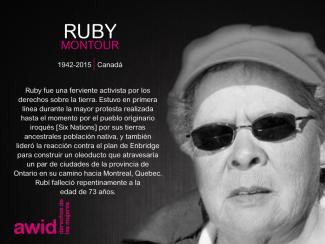
Ruby Montour
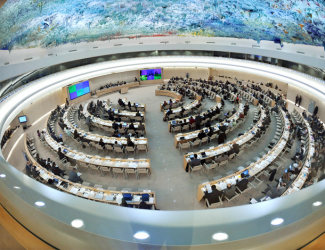
The Human Rights Council (HRC) is the key intergovernmental body within the United Nations system responsible for the promotion and protection of all human rights around the globe. It holds three regular sessions a year: in March, June and September. The Office of the UN High Commissioner for Human Rights (OHCHR) is the secretariat for the HRC.
Debating and passing resolutions on global human rights issues and human rights situations in particular countries
Examining complaints from victims of human rights violations or activist organizations on behalf of victims of human rights violations
Appointing independent experts (known as “Special Procedures”) to review human rights violations in specific countries and examine and further global human rights issues
Engaging in discussions with experts and governments on human rights issues
Assessing the human rights records of all UN Member States every four and a half years through the Universal Periodic Review
AWID works with feminist, progressive and human rights partners to share key knowledge, convene civil society dialogues and events, and influence negotiations and outcomes of the session.
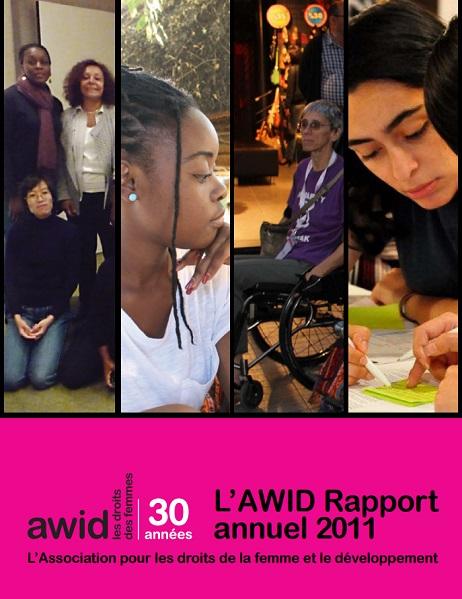
Chaque programme comporte plusieurs volets, y compris le développement et la diffusion de connaissances, la recherche-action, les plaidoyers, l’établissement d’alliances et l’organisation de dialogues stratégiques.
Notre Rapport Annuel 2011 vous proposent un sommaire des principales réalisations pendant l'année, dans le cadre de chacune des programmes de l’AWID.
Participez au Forum international de l'AWID - un rassemblement féministe mondial majeur - et bénéficiez de réductions spéciales et de points d'entrée pour le dialogue virtuel réservés aux membres de l'AWID. Co-créé par des mouvements féministes, le Forum est un espace unique de discussion profonde et d'imagination où nous remettons en question et renforçons notre organisation, et joignons nos luttes et nos réalités féministes.
Gloria Chicaiza, una activista social y ambiental ecuatoriana, fue una ferviente defensora de la tierra y el agua. Desafió el statu quo, al luchar contra un modelo de desarrollo basado en la extracción, y trabajó incansablemente por la justicia ecológica y los derechos de las comunidades afectadas por la minería.
Gloria participó en las acciones de resistencia para la protección del ecosistema en distintas áreas de Ecuador. Con pasión y dedicación, Gloria apoyó al movimiento indígena y ambiental, a sus comunidades y a las organizaciones que se oponen a los proyectos de minería y protegen sus territorios y sus proyectos de vida colectivos. En foros locales e internacionales, se pronunció contra la criminalización del disenso y la resistencia, contra la presión y la violencia ejercidas contra lxs activistas comunitarixs (y, en particular, contra las defensoras de derechos humanos), y a favor de los esfuerzos comunitarios por la soberanía alimentaria y la sustentabilidad.
Fue Coordinadora del Área de Justicia Minera de Acción Ecológica, participó en la Red Latinoamericana de Mujeres Defensoras de Derechos Sociales y Ambientales, e integró la Junta Directiva del Observatorio de Conflictos Mineros de América Latina (OCMAL).
En octubre de 2010, la compañía minera Curimining/Salazar Resources S.A. (con sede en Vancouver, Canadá) acusó a Gloria de auspiciar un acto de terrorismo, sabotaje y asociación ilícita para delinquir. Acción Ecológica consideró que esto fue «en represalia por su trabajo de denuncia de los impactos de las actividades mineras en el país».
En 2014 Gloria apoyó la coordinación de una delegación a la Conferencia Internacional sobre Cambio Climático (COP 20) de la ONU. El grupo estuvo integrado por veinticinco mujeres indígenas de América Latina.
Gloria falleció el 28 de diciembre de 2019 por complicaciones de un trasplante de pulmón. Es recordada por su resistencia y su incansable trabajo.
«El camino más rápido para llegar a la sustentabilidad sigue siendo la resistencia.» - Gloria Chicaiza (entrevista de 2010)
«Para GLORIA. GLORIA Agua. GLORIA Tierra. GLORIA Madre. GLORIA Revolución. GLORIA Hermana. GLORIA Cielo. GLORIAmiga. GLORIAstral. Gracias por entretejernos.» - Liliana Gutiérrez
«Gracias Glorita, por sostener la esperanza, por mantener el tejido fuerte, por conectar la comunidad, por las manos unidas, por la solidaridad, gracias Glorita por acompañarnos en los momentos más difíciles. Gracias por enseñarnos que, a lo largo de la vida, nadie se cansa.» - Chakana News
«Fue más intrépida, más audaz y más generosa que su cuerpo; ese cuerpo que enfrentó toletes y bombas lacrimógenas, que paseó bajo la cadencia de los tambores y las batucadas, que incubó otra vida, hermosa y digna, como la suya. Haz dejado de toser, querida amiga, pero hoy, más que nunca, tu voz me quema adentro.» - Pablo Ospina Peralta
«Gloria Chicaiza valoraba ser una de muchxs, y así prosperaba. Y, humilde como era, tenía una extraordinaria capacidad para llevar y mantener un ritmo sostenido y estruendoso, un pulso de afirmación de la vida que guiaba, movilizaba e inspiraba a las comunidades y a las redes para la protección de la Madre Tierra. Se oponía a toda forma de violencia contra los cuerpos-territorios. Apoyaba el buen vivir.» - Gabriela Jiménez, Coordinadora de Asociaciones para América Latina, KAIROS
«Gracias Gloria Chicaiza, desde el infinito estamos seguros de que seguirás apoyando nuestra lucha.. Tú, que continuaste acompañándonos en la lucha a pesar de que tu salud fallara. Vivirás en los bosques y en el agua que defendiste con tanta valentía, vivirás en nuestros corazones.» - Comunidad de Intag, Ecuador
I believe empowered women empower women and that is why I’ve had an incredible time being an AWID member. My knowledge and understanding of Feminism and intersectionality has been broadened by the exposure I received being part of the AWID Community Street Team. I hope more women join and share topics and ideas that will help other women.
- Loyiso Lindani, South Africa.
AWID is pleased to share our 2016 Annual Report.
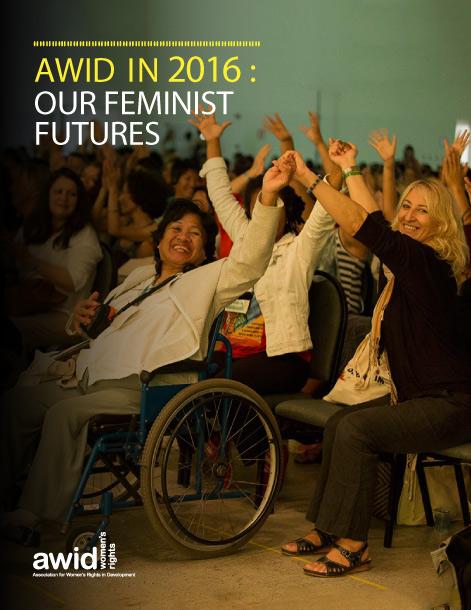
2016 was an incredible year for AWID, we convened the 13th International AWID Forum in Bahia, Brazil, a space for strategizing and alliance building with feminists and other justice movements, which was attended by over 1800 participants from 120 countries and territories across the globe.
We know that women’s rights and feminist movements are key actors in creating sustainable transformative change. Within our movements, organizing, resisting and responding to the challenging context is sharpening, and in our increasingly connected world, the potential for collective action across diverse movements has dramatically grown.
This is the crucial work that AWID seeks to amplify and support every day.
A highlight of 2016 was our ground-breaking 13th International Forum with the theme: “Feminist Futures: Building Collective Power for Rights and Justice”, where we harnessed the thinking and energy of nearly 500 partners, presenters, panelists, moderators, artivists, writers, facilitators, IT innovators, and performers, many of them leaders in their movements. We also supported the convening of the first and historical Black Feminisms Forum (BFF) organised by a working group of Black Feminists from across the world.
AWID, in partnership with other feminist and women’s rights organisations, engaged in advocacy and dialogue to explore better solutions for women’s rights agendas including our work with the Count Me In! consortium .
The experiences of women with disabilities, Black and Afro-descendant women, sex workers, Indigenous women, trans and intersex people, domestic workers and how their lives are impacted by multiple oppressions and violence were placed front and center of the Forum process.
We also launched the 2016 WHRD Tribute to commemorate defenders who are no longer with us, during the 16 Days of activism, and thanks to the contributions from our members,
We drove attention to groups and issues that do not usually receive adequate mainstream media coverage through our partnership with The Guardian and Mama Cash.
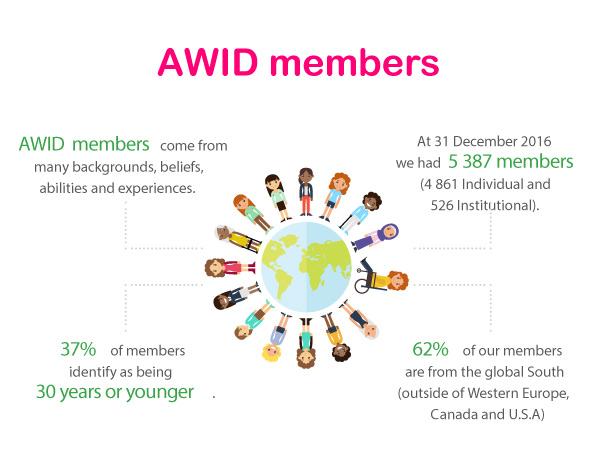
We work towards a world based on social, environmental, and economic justice; and interdependence, solidarity, and respect. We work towards dismantling systems of oppressive power and against all its manifestations, including patriarchy, fundamentalisms, militarisms, fascisms and corporate power that threaten our lives and our world. We want a just world where resources and power are shared in ways that enable everyone to thrive.
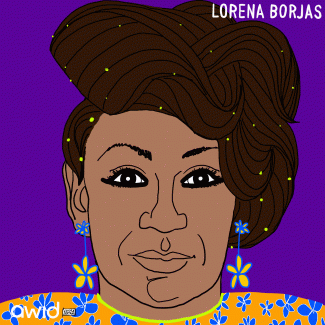
Lorena Borjas, femme trans et activiste latino-américaine, travaillait et vivait dans le quartier de Jackson Heights dans le Queens, à New York. Dans ces rues, pendant des années, elle s’est occupée de sa communauté à plaider en faveur des droits des personnes trans et immigrées, soutenir les individus ayant survécu à la traite des êtres humains et à la maltraitance et défendre les droits des travailleures du sexe et des personnes vivant avec le VIH et le sida.
Lorena se battait avec force, sans relâche, afin d’aider, de défendre et de soutenir les personnes les plus marginalisées et discriminées par la transphobie, la misogynie et le racisme.
« Elle nous a poussé·e·s à briller avec authenticité, à devenir le cri subversif qui affirme “ je suis là et je mérite moi aussi d’être heureux·se ” » - Cecilia Gentili, activiste trans et ami·e de Lorena
Ayant elle-même fait face à de nombreux traumatismes et difficultés en tant qu'immigrée transgenre et victime de la traite des êtres humains, Lorena a puisé dans le puits de ses expériences des connaissances et d’une mémoire émotionnelle afin d'aider à construire et à renforcer la communauté dont elle faisait partie, et qui faisait partie d'elle. Pour ce faire, elle a notamment organisé et mobilisé des aides allant de la fourniture de préservatifs à la mise en relation de femmes trans avec différents services, en passant par la création d'une clinique de dépistage du VIH à son propre domicile.
« C’était une si belle âme qui aidait les autres alors que son parcours d’immigrée, et d’immigrée trans, était difficile et douloureux. Elle était convaincue que la communauté trans avait besoin d’amour, d’acceptation et de compassion, et elle a tout donné. » - Luchia Dragosh, superviseuse de production chez QPTV dans le cadre d’un documentaire sur Lorena
En plus de 25 ans d'activisme, elle a également fondé le Fonds communautaire Lorena Borjas avec Chase Strangio (avocat et activiste des droits des trans), qui aide les nombreux·ses membres de sa communauté (et en particulier les personnes trans) confronté·e·s aux problèmes d'immigration à éviter le cycle arrestation-prison-expulsion.
Lorena est décédée en mars 2020 des suites de complications liées à la COVID-19.
Son oeuvre, gigantesque et merveilleuse, sera poursuivie dans les rues du Queens par le réseau et la communauté qu’elle a cocréés.
« Nous reprendrons son travail là où elle l’a laissé, travail essentiel au bien-être de ses “ pajaras ” (oiselles), comme elle aimait appeler les filles trans du Queens qu’elle avait prises sous son aile. » - Cecilia Gentili
« Lorena nous a apporté de la lumière alors que nous vivions une période très sombre ici à New York. Elle nous a apporté sa lumière alors que nous faisions face à l’ ”épidémie de crack ”, à la crise du sida, aux changements dans les politiques d’immigration. » - Cristina Herrera, fondatrice et directrice générale de Translatina Network et amie de Lorena
« Lorena a fait plus que quiconque pour faire la lumière sur l’épidémie de traite dans les communautés transgenres et permettre à d’autres femmes trans d’échapper à l’exploitation. » - Lynly Egyes (a représenté Borjas pour le compte du Transgender Law Center)
Regardez un documentaire sur Lorena Borjas (seulement en anglais)
Lisez l'article sur Lorena Borjas dans la rubrique Postscript du New Yorker (seulement en anglais)
Lisez un article d'opinion de Cecilia Gentilin dans le New York Times (seulement en anglais)
#FreezeFascisms
Depuis l’adoption de la Déclaration et du programme d’action de Beijing il y a 30 ans, les groupes fascistes exercent un pouvoir et une influence croissantes dans les espaces multilatéraux, faisant reculer les acquis en matière d’égalité de genre et de protection des droits humains dans le monde.
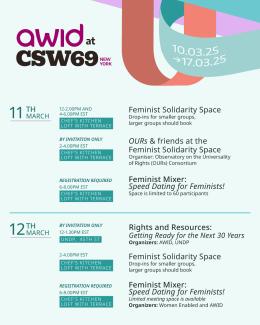
À l’approche de la CSW69, nous co-organisons de courageuses initiatives horizontales, sur le terrain et en ligne, pour échanger des stratégies et bâtir un pouvoir féministe au-delà de Beijing+30. Notre présence collective perturbe les mécanismes d’exclusion des institutions dans ces espaces tout en soutenant les mouvements qui s’organisent autour d’alternatives féministes aux systèmes d’oppression.
Participez aux conversations du 10 au 21 mars 2025 pour, collectivement, faire de la CSW69 un espace de résistance et de solidarité.
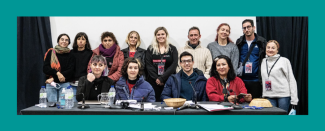
In 2021, AWID, along with many other organizations, was coming to grips with the implications of the on-going global pandemic for how we work and our role in this particular time. The year taught us three critical lessons about navigating this moment as a global feminist movement-support organization.
Download the full 2021 Annual review
Our experience in 2021 reaffirmed the importance of building and sustaining a global feminist community, and AWID’s core mission to support feminist movements as a whole. We believe that at this moment, a strong community bound by a shared vision and collective care is the foundation of all social change and transformation.
Este Foro de AWID celebrará y difundirá las realidades feministas que nos rodean en diferentes etapas de desarrollo.
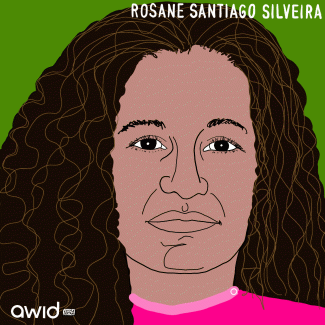
Rosane Santiago Silveira was affectionately known as Rô Conceição. A Brazilian environmental and human rights activist, she fervently fought to protect the environment where it was most threatened.
This included defending it on the island of Barra Velha, where it was endangered by oil exploration, as well as safeguarding it by campaigning against land-grabbing and expansion of eucalyptus plantations in Bahia State, where Rosane was a member of the Cassurubá Extractivist Reserve Council.
“Extractive Reserve is a protected area where resident families make their living off natural products extracted from the forest. These activities help maintain the forest integrity.” - Global Justice Ecology Project (original source: Rede Brasil Atual)
She was part of trade union activities, human rights and cultural movements. Rosane dedicated much of herself to causes that were not only close to her but are also of concern to land, forests, rivers, and communities whose rights and lives are continuously at risk.
She was tortured and murdered on 29 January 2019 in Nova Viçosa, a city in southern Bahia.
“Unfortunately, today there is a feeling of total insecurity, because of the State’s absence in prosecuting these crimes. We were with her at Christmas, and everyone realised that she was worried and now we know that she had received three death threats,” - Tuian, Rosane’s son in an interview with Rádio Brasil Atual (original source: Rede Brasil Atual)

Ritu is a feminist technologist who brings her experience in the non-profit sector, driven by a passion for utilizing innovative approaches to finding feminist technological solutions. Holding a Master's in Technology in Computer Applications from the Indian Institute of Technology, her role at AWID encompasses a diverse range of responsibilities. From overseeing digital security and server management to database administration, capacity building, technology evaluation, software implementation and cloud solutions, Ritu ensures that AWID's IT infrastructure is resilient and effective. Prior to joining AWID, she played a pivotal role in advancing technological initiatives in the Health Promotion and Environment sectors, fueled by her dedication to leveraging technology for social good.
Nous tenons à remercier les personnes qui ont contribué à ce projet et qui ont fourni de précieux conseils :