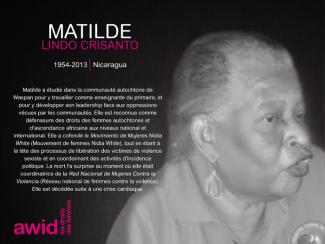
Matilde Lindo Crisanto
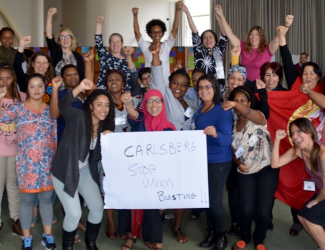
Women human rights defenders (WHRDs) worldwide defend their lands, livelihoods and communities from extractive industries and corporate power. They stand against powerful economic and political interests driving land theft, displacement of communities, loss of livelihoods, and environmental degradation.
Extractivism is an economic and political model of development that commodifies nature and prioritizes profit over human rights and the environment. Rooted in colonial history, it reinforces social and economic inequalities locally and globally. Often, Black, rural and Indigenous women are the most affected by extractivism, and are largely excluded from decision-making. Defying these patriarchal and neo-colonial forces, women rise in defense of rights, lands, people and nature.
WHRDs confronting extractive industries experience a range of risks, threats and violations, including criminalization, stigmatization, violence and intimidation. Their stories reveal a strong aspect of gendered and sexualized violence. Perpetrators include state and local authorities, corporations, police, military, paramilitary and private security forces, and at times their own communities.
AWID and the Women Human Rights Defenders International Coalition (WHRD-IC) are pleased to announce “Women Human Rights Defenders Confronting Extractivism and Corporate Power”; a cross-regional research project documenting the lived experiences of WHRDs from Asia, Africa and Latin America.
"Women Human Rights Defenders confronting extractive industries: an overview of critical risks and Human Rights obligations" is a policy report with a gender perspective. It analyses forms of violations and types of perpetrators, quotes relevant human rights obligations and includes policy recommendations to states, corporations, civil society and donors.
"Weaving resistance through action: Strategies of Women Human Rights Defenders confronting extractive industries" is a practical guide outlining creative and deliberate forms of action, successful tactics and inspiring stories of resistance.
The video “Defending people and planet: Women confronting extractive industries” puts courageous WHRDs from Africa, Asia, and Latin America in the spotlight. They share their struggles for land and life, and speak to the risks and challenges they face in their activism.
Challenging corporate power: Struggles for women’s rights, economic and gender justice is a research paper outlining the impacts of corporate power and offering insights into strategies of resistance.
AWID acknowledges with gratitude the invaluable input of every Woman Human Rights Defender who participated in this project. This project was made possible thanks to your willingness to generously and openly share your experiences and learnings. Your courage, creativity and resilience is an inspiration for us all. Thank you!
Jemimah Naburri-Kaheru is an accomplished international HR strategist with a profound impact within the Horn of Africa Region. Jemimah previously served as the Regional Human Resource and Office Manager at the Strategic Initiative for Women in the Horn of Africa (SIHA). Her influence extends to HR leadership for over 70 regional staff, as the organization experienced rapid growth with a 40% increase in annual revenues. Throughout her career, Jemimah has orchestrated successful recruitment efforts, introduced merit-based performance systems, and overseen employee relations and HR policies.. She played a pivotal role in supporting global workforce strategies. With an academic background in Development Studies from Makerere University (Uganda) and an ongoing MBA in Human Resource Management, Jemimah's commitment to professional development is evident. Her contribution to high-performance workforces and international HR leadership positions her as an invaluable asset to any global enterprise.

To share your lived experience with mobilizing funding for your organizing
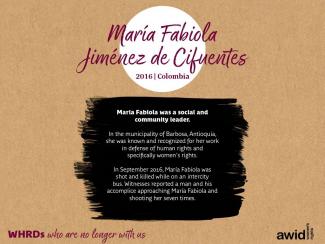
Metzineres
Ekaete Judith Umoh es una defensora internacional de los derechos de las personas con discapacidad y experta en desarrollo inclusivo, con un agudo análisis de las cuestiones relativas al género, la discapacidad y el desarrollo inclusivo. Su sueño es aumentar la visibilidad de las mujeres y niñas con discapacidad dentro del movimiento feminista internacional y en todos las iniciativas para el desarrollo en el mundo.
Ekaete disfruta con el activismo y la política, y llegó a convertirse en la primera mujer elegida presidenta de la Asociación Nacional Conjunta de Personas con Discapacidad -JONAPWD(www.jonapwd.org ), en Nigeria, donde lideró a organizaciones por los derechos de las personas con discapacidad en las luchas por convertir en ley el Proyecto de Ley de Prohibición de la Discriminación contra las Personas con Discapacidad en Nigeria, tras más de 17 años de trabajo constante de incidencia. Posteriormente, se incorporó a CBM Global como Directora de País pionera y dirigió su equipo durante unos tres años, contribuyendo a acabar con el círculo de pobreza y discapacidad en Nigeria. Aparte del activismo en defensa de las personas con discapacidad, Ekaete ha trabajado como consultora para varias agencias de desarrollo, proporcionando asistencia técnica sobre la inclusión de la discapacidad en el diseño de programas y proyectos.

L’enquête est disponible en français, anglais, arabe, espagnol, portugais et russe!
.
Care as the foundation of economies
The COVID-19 pandemic put the global crisis of care into sharp focus and demonstrated the failures of the dominant economic model that is decimating essential public services, social infrastructures and systems of care around the world.
Cozinha Ocupação 9 Julho, the Association of Afro-Descendant Women of the Northern Cauca (ASOM) and Metzineres are only some examples of caring economies that center the needs of marginalized people and nature, as well as the reproductive, invisibilized, and unpaid care work required to ensure the sustainability of our lives, societies and eco-systems.
Alejandra es una apasionada de los derechos de las mujeres y la justicia de género. Sueña con crear un mundo centrado en el cuidado de las personas y de la naturaleza. Como experta feminista en derechos humanos, ha trabajado en las intersecciones de la justicia de género, climática, social y económica en varias organizaciones internacionales. Sus áreas de experticia incluyen la construcción de conocimiento y de la creación conjunta, la investigación, la facilitación y la incidencia. Tiene un título de maestría de la Universidad de Essex, y es autora y colaboradora de muchas publicaciones, que incluyen el artículo «Enraged: Women and Nature». La campaña Feminist Activism Without Fear se basa en entrevistas e investigaciones realizadas por Alejandra.
Nacida en Argentina, durante las últimas dos décadas ha vivido y trabajado en varios países de Europa y América Latina. Alejandra ama la fotografía, el mar, cocinar con su hija y disfrutar de la comida de todo el mundo. Como madre, su objetivo es cambiar los modelos y patrones establecidos. Alejandra obtiene energía e inspiración de las increíbles mujeres de su vida, que están distribuidas en muchos rincones del mundo.
The full “Where is the Money for Feminist Organizing” report will be published in 2026.
To learn more how AWID has been shining a light on money for and against feminist movements check out the work of our Resourcing Feminist Movements Initiative here.
Contenu lié
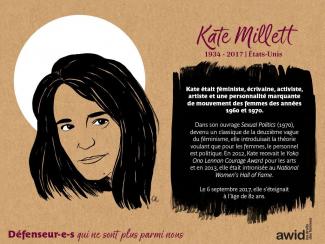
TV5Monde: Kate Millett, décès d'une féministe qui combattait avec caresses et plaisir

Le travail de l’AWID est rendu possible par la générosité d’un large éventail de donateurs, y compris les agences bilatérales et multilatérales, les fondations privées et les fonds pour les femmes.

Le principal objectif de l’enquête WITM est de faire la lumière sur la situation financière de divers mouvements féministes, de défense des droits des femmes, pour la justice de genre, de défense des personnes LBTQI+ et des mouvements alliés dans le monde entier. Sur cette base, nous souhaitons démontrer l’importance d’orienter davantage de fonds, de meilleure qualité, et de transférer le pouvoir vers les mouvements féministes.
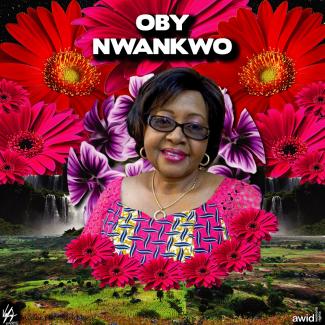
With a legal career spanning more than 30 years, Oby was known across Africa and around the world as a champion for gender justice and human rights.
She founded and served as Executive Director of the Civil Resource Development and Documentation Centre (CIRDDOC), a Nigerian NGO which sponsors trainings and network-building activities for members of civil society, parliamentarians and other key stakeholders to promote human rights, good governance and access to justice and rule of law.
Oby is remembered fondly by activists in Nigeria as an “extraordinary activist who displayed energy and passion towards the fight for gender equality and gender justice in Nigeria and across Africa.”